Dropshipping in South Africa: The Complete 2026 Guide

Dropshipping in South Africa is legal, cheap to start and growing fast, but it doesn't work like the US playbook you see on YouTube. Customs now taxes cheap overseas parcels properly, Shopify Payments isn't available locally, and South African shoppers expect to pay by Instant EFT and collect from a locker. Get those three things right and you have a real business. Ignore them and your margins disappear at the border.
This guide covers everything you need to start dropshipping South Africa-style in 2026: the legal setup (CIPC, SARS, consumer law), local versus international suppliers, the new rules on low-value imports, couriers, payment gateways, platforms, niches that actually sell here, and a step-by-step launch plan with real rand numbers.
Is dropshipping in South Africa worth it in 2026?
The demand side looks healthy. World Wide Worx's Online Retail in South Africa 2026 study projects online retail sales of about R159 billion this year, up roughly 22.5% from around R130 billion in 2025. Online passed 10% of total retail turnover in mid-2026 for the first time. Takealot posted its first full-year trading profit, and Checkers Sixty60 grew sales by 34.5% to R25.5 billion.
That growth is slowing compared with the 35% jump the year before, and part of the reason is that SARS has clamped down on cheap cross-border parcels. For a dropshipper, that's the key point. The opportunity in South Africa has shifted away from “cheap China product, long shipping, big markup” and towards faster local fulfilment, better products and checkout that feels local.
Competition is also thinner than in the US or UK. Plenty of categories on Google.co.za still show big retailers and a few small stores, not twenty polished DTC brands fighting for the same keyword.
Is dropshipping legal in South Africa?
Yes. There's no law against selling goods you don't physically stock. What you do need is to run it like any other trading business. Four things matter.
1. Register your business with CIPC (optional at first, recommended soon)
You can legally trade as a sole proprietor under your own name with no registration at all. The catch is that you're personally liable for everything, and some suppliers, payment gateways and Takealot prefer or require a registered entity.
Most sellers register a private company (Pty) Ltd through the BizPortal site run by the Companies and Intellectual Property Commission. Expect roughly R125 without a name or R175 with a name reservation included, based on the fees BizPortal lists at the time of writing. Registration usually takes a few working days. After that you'll need a business bank account, and you'll file an annual return with CIPC every year.
2. Register with SARS for income tax
A new company is registered for income tax automatically. As a sole proprietor, your store profit goes on your personal ITR12. Either way, keep records of every sale, supplier invoice, ad spend and fee. Our dropshipping taxes guide explains what counts as a deductible cost.
3. VAT registration (only once you're bigger)
South Africa's VAT rate is 15%. From 1 April 2026 SARS applies a higher compulsory VAT registration threshold of R2.3 million in taxable supplies over 12 months, up from R1 million. The voluntary threshold went from R50,000 to R120,000. The amendment was still working through Parliament when SARS started applying it, so confirm the status with a tax practitioner before you rely on it.
Most new stores won't reach that threshold in year one. Some still register voluntarily so they can claim back the import VAT they pay on stock.
4. Follow consumer law
Online sales fall under the Electronic Communications and Transactions Act. Section 44 of ECTA gives buyers a seven-day cooling-off period after delivery to cancel for any reason. You can only charge them the direct cost of returning the goods, and you must refund within 30 days. The Consumer Protection Act adds rights around defective goods, and POPIA governs how you store customer data. Write your refund policy around these rules, not around whatever your supplier's policy says. Our guide to handling returns and refunds has templates you can adapt.
Customs, VAT and the end of the R500 loophole
This is the part most “dropshipping South Africa” guides get wrong, and it affects your pricing more than anything else.
Until 2024, parcels from overseas e-commerce sellers worth under R500 cleared at a flat 20% duty with no VAT. That's why AliExpress and Shein orders were so cheap to bring in. SARS ended that concession in two steps. In a media release dated 8 August 2024, it said VAT would be added on top of the 20% flat rate from 1 September 2024, and from 1 November 2024 the flat rate would be replaced with normal duty rates by product category.
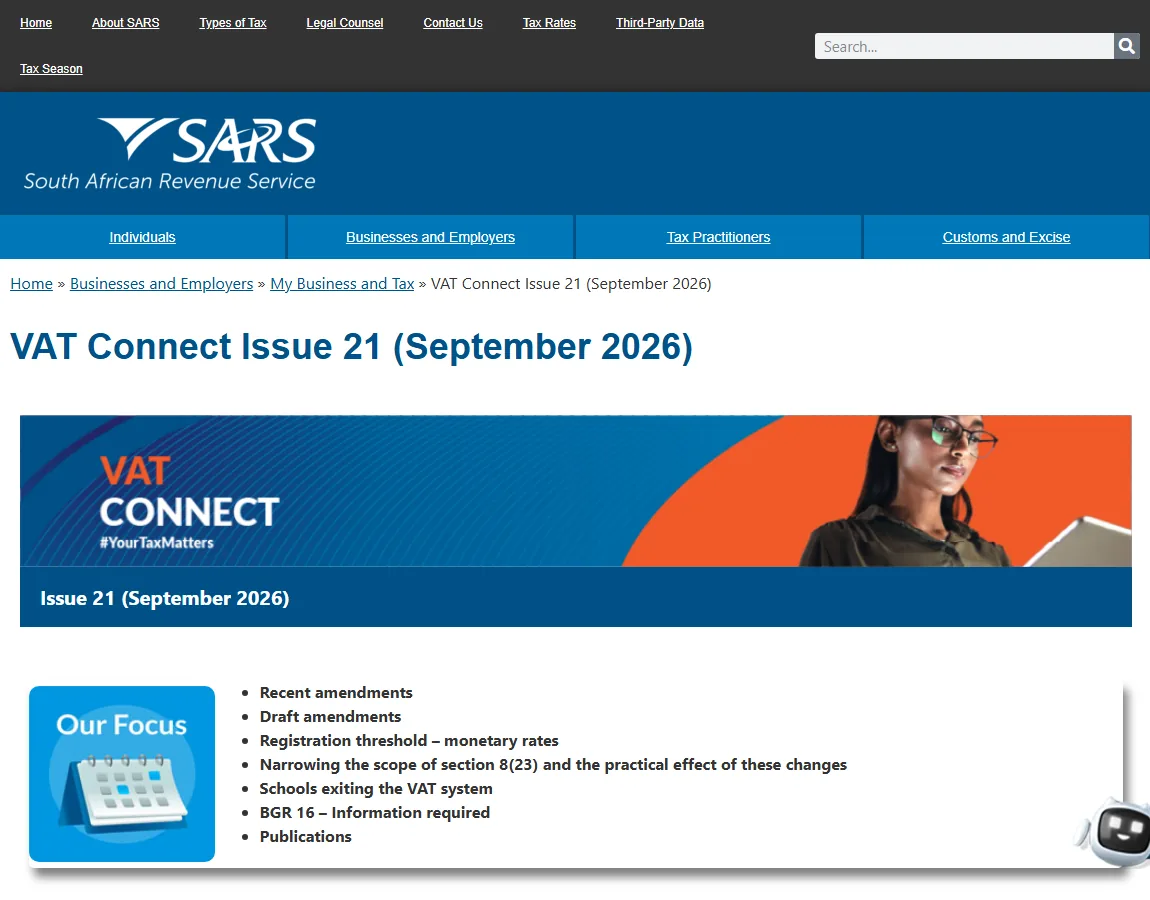
Then in 2026, SARS confirmed in VAT Connect Issue 21 that the VAT exemption for goods with a customs value of R500 or less and no duty payable has been deleted in the latest round of VAT Act amendments. SARS said some offshore suppliers had been splitting orders into parcels worth less than R500 to avoid duty and VAT, and that this hurt local sellers.
What it means in practice: assume every imported parcel pays import VAT plus whatever duty applies to that product's tariff line. Clothing carries some of the highest duty rates, which is exactly what the change was meant to protect. Import VAT is worked out on the customs value plus a 10% uplift plus duty, so it's slightly more than 15% of the price you paid.
A quick example. You sell a R350 phone stand you buy for the equivalent of R120 from a China supplier. Duty and VAT on a low-value accessory can easily add R25 to R50, and the courier may add a clearance fee on top. Who pays? If the customer pays at the door, expect refused parcels and angry reviews. Build it into your price or use suppliers that ship duties-paid (DDP).
Local vs international dropshipping suppliers
You have three realistic options, and most successful SA stores mix at least two of them.
| Supplier type | Delivery time to SA customers | Product cost | Customs risk | Best for |
|---|---|---|---|---|
| Local SA suppliers and wholesalers | 2 to 5 working days | Higher | None for the buyer | Home, beauty, baby, gadgets, fast-moving stock |
| China suppliers (AliExpress, CJ, agents) | About 10 to 25 days, varies by line | Lowest | Duty and VAT on every parcel | Testing products, light accessories |
| US/EU suppliers | About 7 to 14 days, varies | Highest | Duty and VAT, plus higher shipping | Branded or premium goods with high margins |
South African dropshipping suppliers to look at
The local supplier scene is small, so vet each one before you list their stock. A few that are actually operating:
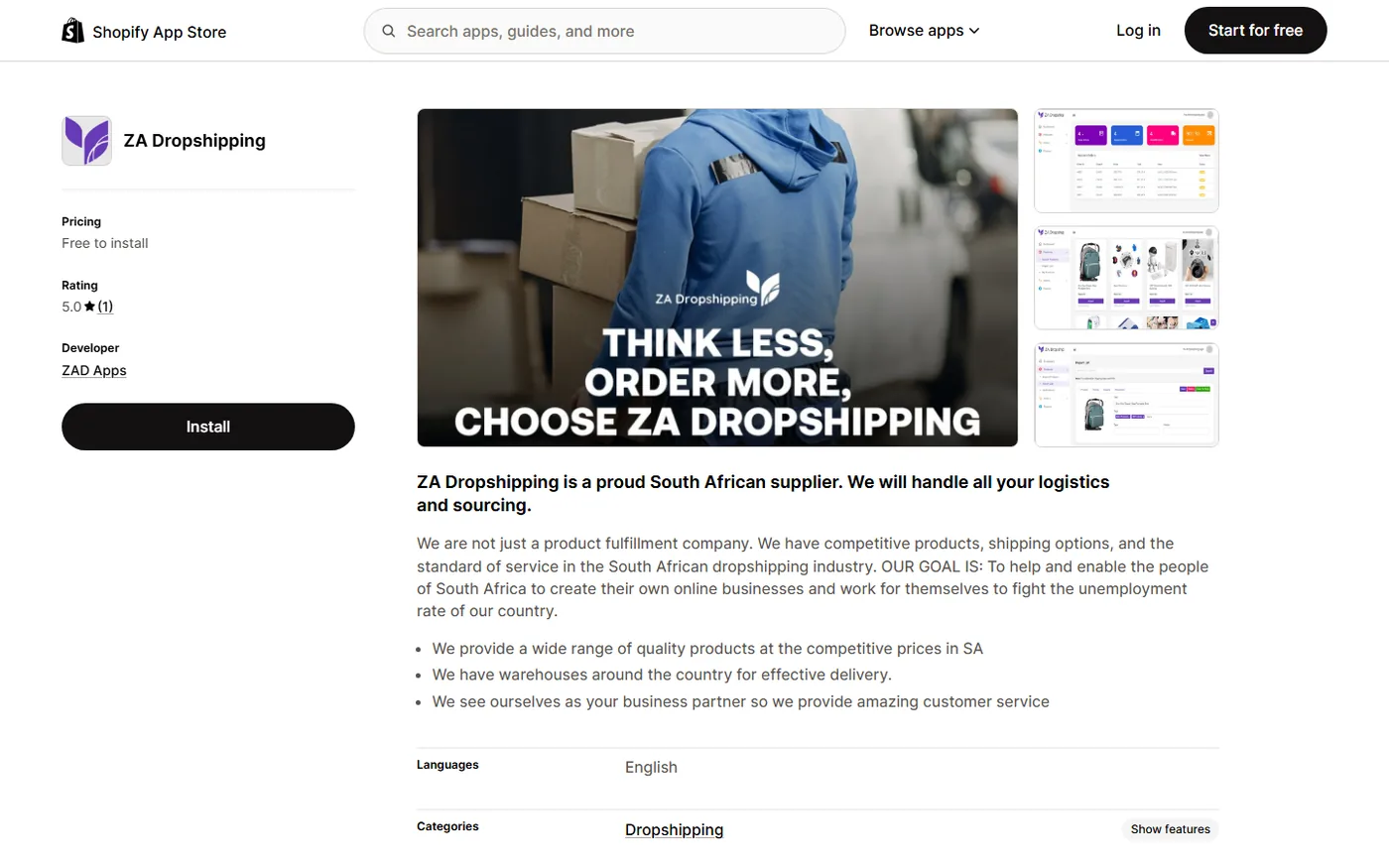
- ZA Dropshipping (ZAD Apps). A South African supplier with a Shopify app. It covers home and garden, health and beauty, electronics, baby, furniture and hardware, with products stocked in South Africa and Kenya. The app is free to install. It only had one review when we checked, so order samples first.
- Dropstore. A local dropshipping marketplace that connects stores with South African suppliers and integrates with Shopify and WooCommerce. It's promoted by the Bob Group (Bob Go, Bob Shop), which also runs courier tools for SA merchants.
- Direct wholesaler deals. Plenty of local importers and distributors in Johannesburg, Durban and Cape Town will ship single orders for you if you ask. They don't call it dropshipping and they don't have an app. Phone them, agree a price list and a dispatch cut-off time, and send orders by email or a shared sheet until you have volume.
International suppliers
AliExpress still works for testing, but read our AliExpress alternatives roundup before you commit. Agents and platforms like CJdropshipping can consolidate stock and sometimes offer faster lines to South Africa (our CJ Dropshipping review covers how that works). Whichever you use, ask about the shipping method, who pays duties and what happens with a refused parcel before you list anything. Our guide to finding dropshipping suppliers has a full vetting checklist.
A sensible approach is to test with an overseas supplier. Once a product sells 5 to 10 a day, bring in a small batch to a local 3PL or your garage and ship it yourself. That's hybrid dropshipping, and in South Africa it's often the difference between a store that grows and one that drowns in “where's my order?” emails.
Shipping and couriers in South Africa
Local delivery is where you win customers back from Temu and Shein. The couriers most SA stores use:
- The Courier Guy. Probably the most common choice for online stores, with door-to-door delivery and Shopify and WooCommerce plugins that generate waybills automatically. It also runs Pudo smart lockers, which are cheap and handy for customers who aren't home in the day.
- Aramex South Africa. Door-to-door and counter-to-counter options, plus international inbound if you import stock.
- PostNet. A big franchise counter network, useful for counter-to-counter parcels and for customers in smaller towns.
- Pargo. Click-and-collect at thousands of retail pickup points such as Clicks and other stores.
- Bob Go and Shiplogic. Not couriers but shipping software. They compare rates across couriers, print labels and push tracking into Shopify.
Rough rates: locker-to-locker for a small parcel starts around R50 to R60, and next-day door-to-door between cities can go past R200 on standard rates. Contract rates are lower once you ship volume, so get quotes once you're doing 100+ parcels a month. Many stores offer free delivery over R500 to R750 and charge R70 to R100 below that, which pushes basket size up.
Tip: offer locker or pickup point delivery as the default for small items. It costs less than door-to-door, delivery fails less often, and South African shoppers already know how it works.
Payment gateways for South African stores
Shopify Payments isn't available in South Africa, so you'll connect a third-party gateway. Shopify also adds its own transaction fee on top when you use an external gateway, which varies by plan, so check your plan's rate on Shopify's pricing page.
| Gateway | What it's good at | Published online card fee |
|---|---|---|
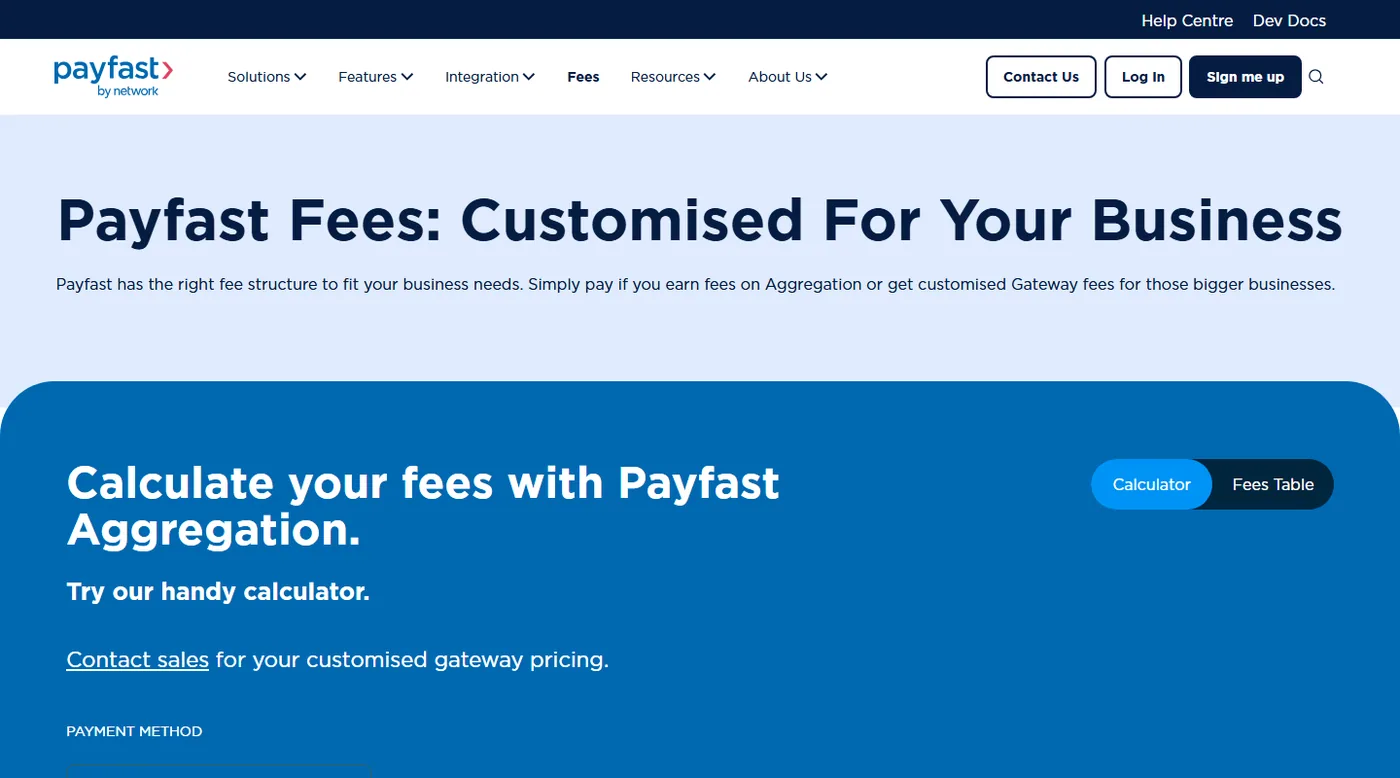
| PayFast (by Network) | Most common Shopify/WooCommerce choice, cards plus Instant EFT, Capitec Pay, SnapScan and more | 3.2% + R2.00 per card transaction; Instant EFT 2% (min R2); standard payout R8.70 |
| Yoco | Simple setup, good if you also sell in person at markets | Check Yoco's live rate page; online rates sit a little above its card machine rate |
| Peach Payments | Wider payment methods and better rates as you scale | Plan-based, quoted on its pricing page |
| Ozow | Instant EFT specialist, paying straight from a bank account with no card | Percentage-based EFT pricing, usually cheaper than cards |
PayFast's figures above come from its own fees page (excluding VAT). On a R500 card sale, that's R18. Rates change, so check each provider's live page before you choose.
Offer Instant EFT no matter which gateway you pick. A lot of South Africans don't like typing card details into a store they don't know, and EFT conversion can be noticeably higher on a new brand. Cash on delivery is rare and risky for a new store, so skip it.
Which platform should you sell on?
Shopify
The default for most new stores. Plans are billed in US dollars, it has apps for every SA gateway and courier mentioned above, and it's the easiest to run. Price your store in rand and show prices VAT-inclusive if you're registered.
WooCommerce
Cheaper month to month if you're comfortable with WordPress, and there are good SA plugins for PayFast, Ozow and The Courier Guy. More maintenance, though. See our Shopify vs WooCommerce comparison before deciding.
Takealot Marketplace
Takealot is where a huge share of South African online shoppers start their search, so it's tempting. Know the trade-offs. Takealot charges a monthly seller subscription (widely reported at R400 excluding VAT) plus a success fee that varies by category. It expects you to either send stock to its distribution centres or ship within its leadtime rules from your own stock. That doesn't fit the “order from China after the customer pays” model. It does fit a hybrid model where you hold a few fast-moving SKUs locally. Check the current fee schedule in the Takealot Seller Portal before you list anything.
Other options
Bob Shop (formerly bidorbuy), Makro Marketplace and Amazon.co.za also exist. Amazon launched in South Africa in 2024. Each has its own seller rules, so test one channel properly before adding another.
Niches that sell well in South Africa
South Africa has its own seasons, habits and pain points. Products that do well here:
- Load-shedding and backup power accessories. Rechargeable LED bulbs, small power stations, UPS units for routers, solar lights. Demand rises and falls with Eskom's schedule. When the power goes off, these move fast.
- Security and home safety. Wi-Fi cameras, motion sensor lights, smart locks and car trackers. Steady demand all year.
- Braai and outdoor gear. Braai tools, cast-iron potjie accessories, camping and 4x4 overlanding gear. Peaks before December and Easter.
- Beauty and haircare for South African hair types. Wig accessories, silk bonnets, heatless styling tools and natural hair care products.
- Baby and kids. Feeding, sleep and car-seat accessories. Parents buy online because they don't have time to shop.
- Pets. Dog beds, harnesses, enrichment toys and grooming tools.
- Fitness and sport. Rugby and cricket fan gear (watch licensing), home gym accessories, running gear.
Before you pick, check what's actually selling. Dropshiptool's Product Database and Sales Tracker show which products Shopify stores are moving right now, so you're working from sales data rather than guesswork. If you want a shortlist to start with, you can create a free Dropshiptool account and filter by niche.
How to start dropshipping in South Africa: step by step
- Set a budget. A lean start looks like this: Shopify plan (around US$29 to US$39 a month on Basic depending on billing), a domain (R100 to R200 a year for .co.za), samples (R500 to R1,500) and an ad test budget of R3,000 to R6,000. Around R6,000 to R10,000 gets you a proper first test. See our real cost breakdown for the hidden fees.
- Pick a niche and 3 to 5 test products. Use sales data and Google Trends set to South Africa. Avoid anything bulky, fragile or heavily duty-loaded unless the margin covers it.
- Choose your supplier mix. Local where you can, overseas for testing. Order samples to your own address so you see the real delivery time and any customs charges.
- Register what you need. Sole prop to test, then a (Pty) Ltd via BizPortal once you're getting orders. Open a business bank account.
- Build the store. Prices in rand, a clear delivery time on every product page, an ECTA-compliant returns policy, POPIA privacy policy, and a physical contact address and phone number. SA buyers check for these.
- Connect payments and shipping. PayFast or Peach plus Instant EFT. The Courier Guy or Bob Go for rates and labels, with a locker or pickup option.
- Price with duties included. Supplier cost + shipping + duty/VAT + gateway fee + ad cost per sale. If the margin is still under 30% after that, find a different product. Our pricing guide walks through the formula.
- Market it. Meta and TikTok ads work well in SA and CPMs are generally lower than in the US. WhatsApp is how people talk here, so add a WhatsApp chat button and use it for order updates.
- Look after customers. Send tracking numbers quickly and reply on WhatsApp the same day. Process refunds inside the 30-day ECTA window. Word of mouth travels fast in SA.
Common mistakes South African dropshippers make
- Pricing as if the R500 rule still exists. It doesn't. Every overseas parcel can now attract VAT and duty.
- Letting customers pay customs on delivery. Refusals and chargebacks follow. Include it in your price.
- Promising “3 to 5 days” on China stock. Under ECTA you must state delivery terms honestly, and buyers here will complain loudly if you don't.
- Card-only checkout. Add Instant EFT. It's normal here.
- Selling fake branded goods. Counterfeit sports jerseys and sneakers get seized at customs and can bring criminal charges under the Counterfeit Goods Act. Stick to unbranded or properly licensed products.
Getting started
Dropshipping in South Africa makes sense in 2026 if you treat it as a local business: register properly, price in import VAT and duty from day one, offer EFT and locker delivery, and shift your winning products to local stock as soon as they prove themselves. The market is still growing at more than 20% a year, and most categories aren't crowded yet.
Start with data, not hunches. Sign up for Dropshiptool to see which products Shopify stores are selling right now, then build your South African store around the ones that fit local demand.