The Free Dropshipping Guide PDF for Beginners (2026)
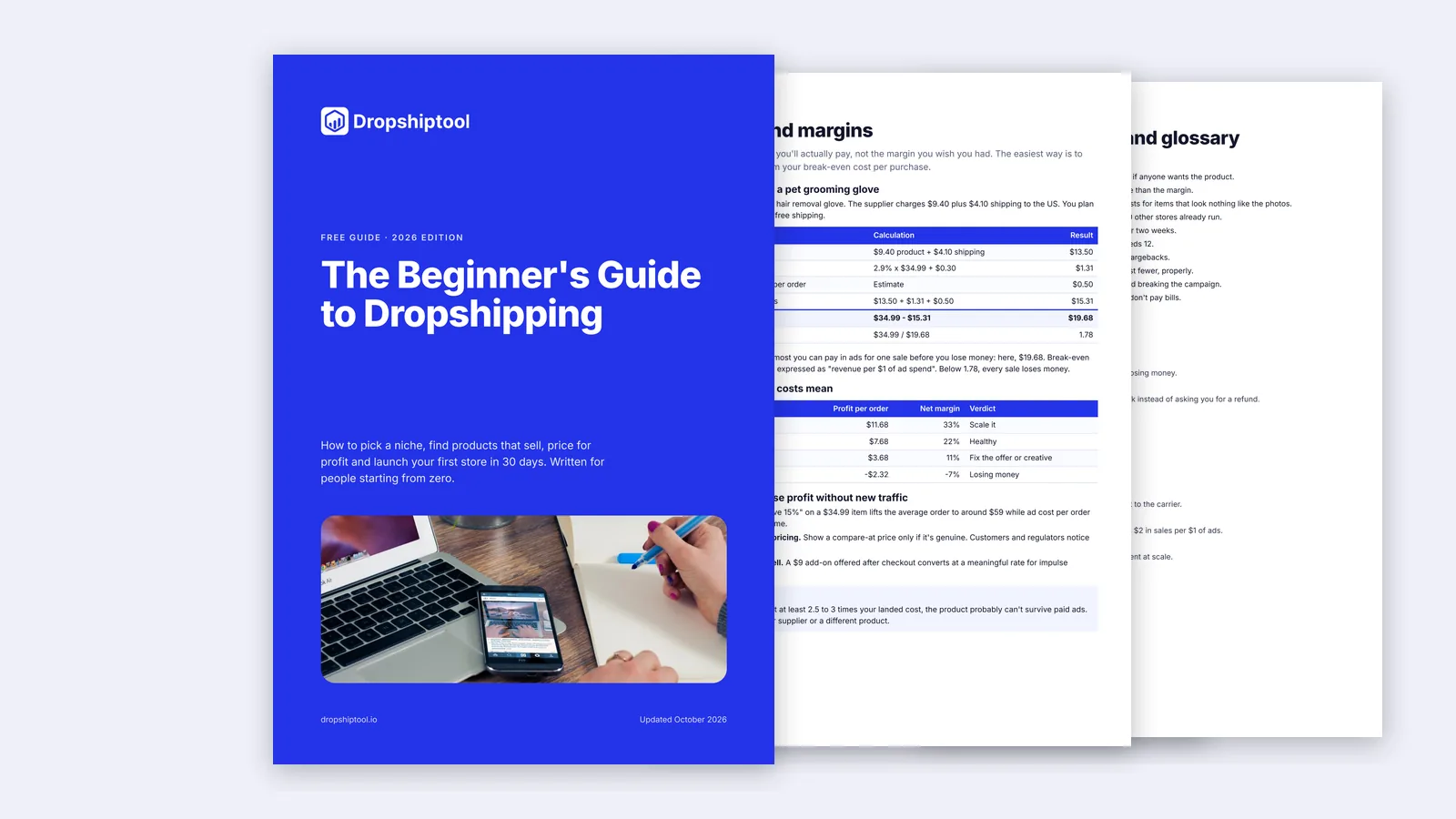
A 14-page beginner's guide to dropshipping that takes you from picking a niche to your first ad test, with real numbers instead of hype. It covers products, suppliers, pricing with a worked margin example, store setup and a day-by-day 30-day launch plan. Download it free, no email required.

What's inside the free dropshipping guide PDF
The guide is 14 pages and takes about 40 minutes to read. It's written for someone starting from zero: no store, no supplier, no ad account. Each chapter ends with a short "do this today" task, because reading about dropshipping is easy and starting is the part most people skip. Here's what each chapter covers.
| Chapter | What you'll learn |
|---|---|
| 1. How the money moves | The order flow from customer to supplier, and where every dollar of a $34.99 sale actually goes |
| 2. Is it still worth it in 2026? | Honest pros and cons, plus a starting budget of $300 to $1,000 broken down line by line |
| 3. Choosing a niche | A six-point scorecard (out of 30) for niche ideas, and which niches to avoid on a first store |
| 4. Finding winning products | Four places to look and a 10-point validation checklist to run before you spend on ads |
| 5. Suppliers and test orders | AliExpress vs US/EU suppliers vs agents, how to judge a supplier, and what to check in a sample |
| 6. Pricing and margins | A worked example that gets you to break-even CPA and break-even ROAS in six steps |
| 7. Building your store | Must-have pages, the settings people forget, and what a product page that converts looks like |
| 8. Getting your first sales | Picking one traffic channel, a simple ad test structure and the four metrics worth watching |
| 9. Running it day to day | A 30-minute daily routine, refunds, chargebacks, and the tax basics for US, UK and EU sellers |
| 10. 30-day launch plan | A day-by-day schedule from setting goals to your day-30 scale-or-switch decision |
| 11. Mistakes and glossary | Ten mistakes we see every week, and plain definitions of CPA, ROAS, AOV, landed cost and more |
Who this beginner's guide to dropshipping is for
It's for people who want to try dropshipping properly on a small budget and would rather see the maths up front than find out after spending $600 on ads. You'll get the most out of it if you have 5 to 10 hours a week for the first month and a test budget you can afford to lose.
- Complete beginners who keep hearing about dropshipping but don't know what to do first. Start with the dropshipping overview if you want the short version, then read the PDF.
- People who tried once and stalled. Usually the product was priced at 2x cost or the store took three weeks to build. Chapters 6 and 10 fix both.
- Side-hustlers comparing options. Chapter 2 compares dropshipping with print on demand, wholesale and private label so you can pick the model that fits.
- eBay and marketplace sellers moving to their own store. If you sell on eBay first, run your numbers through the eBay fees calculator alongside Chapter 6.
It's not for anyone looking for a store that runs itself after a weekend of setup. The guide says plainly that a 20% net margin is a good result, and that ad costs decide most outcomes.
What you need before you start
Less than most courses suggest. The guide's starting checklist is short:
- A budget of roughly $300 to $1,000. Most of it goes on ad testing, not the store. Test orders ($30 to $80) are the one line you should never skip.
- 5 to 10 hours a week for the first month.
- A payment method for your store platform and ad accounts.
- A separate email address and, ideally, a separate bank account, so business costs are easy to track at tax time.
You don't need a company registered on day one, a logo, or a paid research tool. Chapter 9 explains when registering a business and collecting sales tax or VAT starts to matter.
A preview of the 30-day launch plan
Chapter 10 is the part most readers print. It turns the whole guide into a schedule, so you're never wondering what to work on next. If you fall behind, push the dates back. Don't skip steps. Here's a condensed version:
| Days | Focus | What you do |
|---|---|---|
| 1 to 2 | Goals and budget | Set a test budget, a review date and an income goal. Open a business email and bank account. |
| 3 to 9 | Niche and product research | Score 10 niches, keep 3, then shortlist 10 products and run each through the validation checklist. |
| 10 to 13 | Suppliers and pricing | Contact 3 suppliers per product, order samples, build your margin sheet and break-even numbers. |
| 14 to 21 | Store and content | Build the store, film 5 short videos with your samples, then place a real test order on your own site. |
| 22 to 27 | Launch and first cuts | Start the test campaign, leave it alone for 72 hours, then kill losers and make variations of the best hook. |
| 28 to 30 | Optimise and decide | Add a bundle or upsell, fix the weakest funnel step, then compare results with break-even. |
Day 30 ends with a clear rule. If your cost per purchase is below break-even, raise budgets by 20 to 30% every two days. If it's within 20% of break-even, fix the offer before giving up. If a product has spent 1.5 to 2 times break-even with no sales, move on. Most winners aren't the first product tested, which is why the plan pushes you to start your research from proven sellers on pages like winning products and trending products.
The worked margin example from the PDF
Most beginners see "sell for $35, buy for $10" and assume a $25 profit. Chapter 6 walks through a real-world product instead: a pet hair removal glove. The supplier charges $9.40 plus $4.10 shipping to the US, and you sell it at $34.99 with free shipping.
| Step | Calculation | Result |
|---|---|---|
| Landed cost | $9.40 product + $4.10 shipping | $13.50 |
| Payment fees | 2.9% x $34.99 + $0.30 | $1.31 |
| Apps and misc. per order | Estimate | $0.50 |
| Total cost before ads | $13.50 + $1.31 + $0.50 | $15.31 |
| Break-even CPA | $34.99 - $15.31 | $19.68 |
| Break-even ROAS | $34.99 / $19.68 | 1.78 |
So you can pay up to $19.68 in ads for each sale before you lose money. At a $12 cost per purchase you keep $7.68 an order, about 22% net. At $22 you lose $2.32 on every sale. Same product, same store, opposite results. That gap is why the guide spends so long on ad testing.
The rule of thumb that comes out of it: if the retail price isn't at least 2.5 to 3 times your landed cost, the product probably can't survive paid ads. For what those margins look like across a whole month, see how much dropshippers make.
Why a PDF guide instead of scattered videos
You can learn dropshipping from YouTube and TikTok. Plenty of people do. The problem is order. One video tells you to pick a product first, the next says build the brand first, and a third is really an ad for a course. You end up with 40 saved videos and no store.
A dropshipping for beginners PDF fixes that in a few ways:
- It's in sequence. Each chapter builds on the last, and the launch plan points back to the chapter you need for each step.
- It works offline. Print the checklists, keep the margin table next to your laptop, mark up the 30-day plan with a pen.
- The numbers are shown, not hinted at. Budgets, fees and break-even maths are written out so you can swap in your own costs.
- No upsell inside. It mentions tools where they save time, but nothing in the guide requires buying anything.
Videos are still useful for one thing the PDF can't do: showing you an app's screens. Once you reach Chapter 7, pair it with our step-by-step on how to dropship on Shopify.
Get the free dropshipping guide
No email, no signup form, no drip sequence. Click the link and the PDF opens. Download the free dropshipping guide PDF (14 pages).
When you get to product research in Chapter 4, you can do it by hand with ad libraries and marketplace bestseller lists. Or you can use Dropshiptool's Product Database, Sales Tracker and Ad Spy to see which products real Shopify stores are selling and advertising right now. Start a free trial when you're ready to test.
Weekly Drops delivers curated products with demand and margin potential. so you can stay ahead of trends and keep testing new winners.


Trusted by Dropshippers Who Want Data, Not Guesswork

Dropshiptool is fantastic! It simplified product research and helped me find winning items quickly. Highly recommend it for boosting your dropshipping business!

Great tool for beginners and pros alike. The features are intuitive and useful, though the database could update faster. Still, it’s worth using!

Excellent app! The competitor analysis and profit tracking features are spot-on. It’s a must-have for serious dropshippers.

Dropshipping Guide PDF FAQs
Read the guide, then start a free trial and find your first product with real sales data.
Is the guide really free?
Do I need to sign up to download it?
Is this dropshipping guide PDF up to date for 2026?
How much money do I need to start dropshipping?
How long does the guide take to read?
Can I really launch a dropshipping store in 30 days?
Can I print or share the PDF?

The Most Powerful, All-in-One Spy Tool.