Dropshipping: Start an Online Store Without Holding Stock
Dropshipping is a way to run an online store where a supplier ships products straight to your customers, so you never buy or store inventory. This guide covers how it works, what it costs in 2026, real margin math, the legal rules and how to start a dropshipping business in 8 steps.

What is dropshipping?
Dropshipping is a retail model where you sell products online but never stock them yourself. A customer buys from your store, you pass the order to a supplier, and the supplier ships it straight to the customer. You keep the difference between your retail price and what the supplier charges.
That's the whole trick. No warehouse, no pallets of unsold stock, no packing tape. What you do own is everything the customer sees: the store, the product choice, the price, the ads and the support inbox. If a parcel goes missing, the customer emails you, not the supplier.
Because the upfront cost is low, a dropshipping business is one of the most popular ways to start selling online. It's also why competition is heavy. The product you pick and how you market it decide almost everything.
Dropshipping vs. buying stock upfront
Say you want to sell a $30 LED desk lamp. With a traditional store you'd buy 300 units at $8 each, pay $2,400 before your first sale, and store them somewhere. If the lamp flops, you're stuck with boxes. With dropshipping you list the same lamp, run a small ad test, and only pay the supplier after a customer pays you. If it flops, you delete the listing and lose your ad spend, nothing more.
The catch is the per-unit price. Buying 300 lamps might get you $8 each; dropshipping one at a time might cost $12 plus shipping. You're paying for flexibility, and that comes out of your margin.
How dropshipping works
Here's what happens to a single order, from click to doorstep:
- A shopper sees your ad or listing and buys a $34.99 posture corrector from your store.
- Your store charges their card. The full $34.99 lands in your account (minus payment fees).
- Your supplier app sends the order to the supplier, or you place it manually.
- You pay the supplier their wholesale price plus shipping, say $11.
- The supplier picks, packs and ships the parcel, usually with no supplier branding on it.
- Tracking syncs back to your store and the customer gets a shipping email.
- You handle anything after that: “where's my order” emails, returns and refunds.
Who does what:
| Task | You (the store owner) | Supplier |
|---|---|---|
| Product research and pricing | Yes | No |
| Store, product pages, ads | Yes | No |
| Holding inventory | No | Yes |
| Packing and shipping | No | Yes |
| Customer service and returns | Yes | Helps with defective items |
| Legal responsibility to the buyer | Yes | No |
That last row trips people up. The buyer's contract is with you, so late or broken orders are your problem to fix. We walk through the full order cycle step by step in how does dropshipping work.
Pros and cons of a dropshipping business
The good parts are real, and so are the bad ones.
| Pros | Cons |
|---|---|
| Start for a few hundred dollars instead of thousands in stock | Thin margins once ads and fees come out |
| Test ten products without buying any of them | Easy to copy, so winning products saturate fast |
| Run it from a laptop, part-time at first | You don't control stock levels or packaging |
| Scale up without renting a warehouse | Shipping from overseas can take weeks |
| Swap products when trends change | You take the blame for supplier mistakes |
Our honest take: dropshipping is a great way to learn product research, ads and customer service on a small budget. It's a bad fit if you want passive income in month one. Expect to spend the first 60 to 90 days testing products that don't work.
Is dropshipping still worth it in 2026?
It is, but the easy version is gone. More stores compete for the same ad space, US buyers now pay duties on imported parcels, and shoppers expect delivery in a week, not a month. The stores that still make money do three things well: they pick products with proof of demand, they use suppliers with local warehouses where they can, and they price for real margins instead of racing to the bottom. If you're willing to treat it like a small retail business rather than a side hustle trick, the model still works.
How much does it cost to start dropshipping?
A lean Shopify dropshipping store costs roughly $150 to $800 to launch, and most of that range is ad budget. Prices below were checked in October 2026.
| Cost | Typical price | Notes |
|---|---|---|
| Shopify Basic plan | $25/month, or $19/month billed yearly | 3-day free trial, then $1/month for 3 months (Shopify pricing) |
| Payment processing | 2.9% + 30¢ per online card sale on Basic | Extra 2% platform fee if you use a third-party gateway |
| Domain name | About $10 to $20/year | Optional at first, but buyers trust a real domain |
| Supplier app | $0 to $39.99/month | CJdropshipping is free to join; Spocket starts at $39.99/month and AliDrop at $39/month, both with 7-day trials |
| Theme | $0 | Shopify's free themes are fine to start |
| Sample orders | $30 to $100 | Order your own product before you run ads on it |
| Ad testing budget | $300 to $600 | Roughly $20 to $30/day for two to three weeks |
| Business registration | $0 to a few hundred dollars | Depends on your state or country; many start as sole proprietors |
You can launch with less, but a store with no ad budget usually means no data. Organic TikTok content is the main exception, and it costs time instead of money.
Dropshipping profit margins, with real math
Most dropshippers aim to sell at about three times their landed cost (product plus shipping). That sounds greedy until you see where the money goes. Here's one sale of a $39.99 pet grooming glove on the Shopify Basic plan:
| Line | Amount |
|---|---|
| Retail price | $39.99 |
| Product cost | −$9.00 |
| Shipping to customer | −$4.00 |
| Shopify Payments fee (2.9% + 30¢) | −$1.46 |
| Ad cost per purchase | −$15.00 |
| Profit per order | $10.53 (26% margin) |
Now drop the price to $24.99 with the same costs. Profit falls to −$4.03. You lose money on every order. This is why cheap products with paid ads rarely work, and why ad cost per purchase is the number to watch every day.
A 20% to 30% net margin is a healthy target. Repeat customers and email flows push it higher because you don't pay for that second sale. For income ranges at different store sizes, see how much dropshippers make. Selling on eBay instead? Run your numbers through the eBay fees calculator first.
Is dropshipping legal?
Yes. Dropshipping is legal in the US, UK, EU, Canada and Australia. It's a normal supply arrangement that big retailers use too. What gets stores in trouble is how they run it, not the model itself.
Shipping promises (FTC Mail Order Rule)
In the US, the FTC's Mail, Internet, or Telephone Order Merchandise Rule says you must have a reasonable basis for any shipping time you advertise. If you state no time, you must be able to ship within 30 days. If you can't, you have to tell the customer, offer a free way to cancel, and refund cancelled card orders within seven working days. Store credit doesn't count as a refund.
Duties on imported orders (de minimis)
This changed a lot. US duty-free treatment for parcels under $800 was suspended for all countries on August 29, 2025 (CBP notice), and CBP's June 2026 interim rules made that suspension indefinite and set a new entry process for mail (Thompson Hine summary). In plain terms, a $15 item shipped from China to a US buyer now owes duties. Ask suppliers whether their price includes duties (DDP) and build that into your landed cost.
Tax, trademarks and product safety
- Sales tax: in the US you may owe it in states where you pass sales thresholds. Shopify can calculate it, but registering is on you.
- EU VAT: orders up to €150 shipped from outside the EU usually go through the Import One-Stop Shop (IOSS).
- Trademarks: never sell knockoffs of branded goods. Payment processors and Shopify will close the store.
- Safety: kids' products, electronics and cosmetics have extra rules. Ask the supplier for test certificates.
This is general information, not legal advice. Talk to an accountant once you're doing steady sales.
How to start dropshipping in 8 steps
- Pick a niche from data, not a hunch. Look for products that other stores are already selling. The Product Database lets you filter by sales, price and launch date.
- Validate demand. Check how many stores sell it, whether ads are still running, and if sales are climbing or flat. Two or three active competitors is a good sign. Fifty is a warning.
- Choose a supplier and order a sample. Test shipping speed and quality yourself. A product that arrives broken will cost you refunds and ad accounts.
- Set up your store. Shopify is the easiest place to start. Our guide on how to dropship on Shopify covers the setup click by click.
- Price with the margin math. Aim for about 3x landed cost, then check the numbers still work after your expected ad cost per purchase.
- Write honest policies. Real shipping times, a clear returns window and a contact email. Vague policies cause chargebacks.
- Launch a small test. Run one product with two or three ad creatives on Meta or TikTok for a few days. Kill what doesn't get sales and move budget to what does.
- Measure, then scale or cut. Track ad cost per purchase, refund rate and delivery times weekly. Scale slowly when profit holds for a week or more.
Want the long version? Our free dropshipping guide breaks every step down further.
Dropshipping suppliers and platforms
Your supplier sets your shipping speed, product quality and a big chunk of your margin. The main options:
| Supplier type | Best for | Trade-off |
|---|---|---|
| Spocket (US/EU suppliers) | Faster local delivery and branded invoicing | Higher unit costs than overseas suppliers |
| AliDrop (AliExpress products) | Huge catalog and low product costs for testing | Longer shipping and duties on US orders |
| CJdropshipping | Sourcing requests, custom packaging, warehouses in several countries | Quality varies by factory, so samples matter |
| Wholesale or direct from a manufacturer | Best margins once a product is proven | Needs volume, negotiation and sometimes minimum orders |
Most stores start with an app supplier and move to a private agent or wholesale deal once one product sells steadily.
How to vet a dropshipping supplier
- Processing time: how many days between your order and the parcel leaving the warehouse? Anything over three is slow.
- Tracking: every order should get a tracking number that actually updates.
- Stock syncing: the app should update inventory automatically, or you'll sell items that are out of stock.
- Defect policy: ask what happens when a product arrives broken. Good suppliers reship or refund without a fight.
- Reviews and order history: check ratings and recent order volume before you list anything.
Where to sell
- Shopify: the default for most dropshippers, with the biggest app ecosystem.
- WooCommerce: cheaper software, more setup and maintenance.
- TikTok Shop: strong for impulse products that demo well on video.
- eBay and Amazon: built-in traffic, but strict rules on supplier shipping and seller performance.
Common dropshipping mistakes
- Selling products nobody has proven. Gut feel loses money. Start from items already selling for other stores.
- Pricing too low. A $19.99 product almost never survives paid ads.
- Skipping the sample. You find out the zipper breaks after 200 orders and a wave of refunds.
- Hiding shipping times. “Fast shipping” on a 15-day product is how chargebacks start.
- Ignoring duties. Since the de minimis change, imported orders to the US cost more than the supplier's listed price.
- Quitting after one product. Most stores test five to ten products before one works.
- Scaling too fast. Doubling ad spend overnight usually doubles your cost per purchase too.
Using Dropshiptool to pick dropshipping products
Product choice is the hardest part of dropshipping, so that's what Dropshiptool is built around. Instead of guessing, you look at what's selling right now.
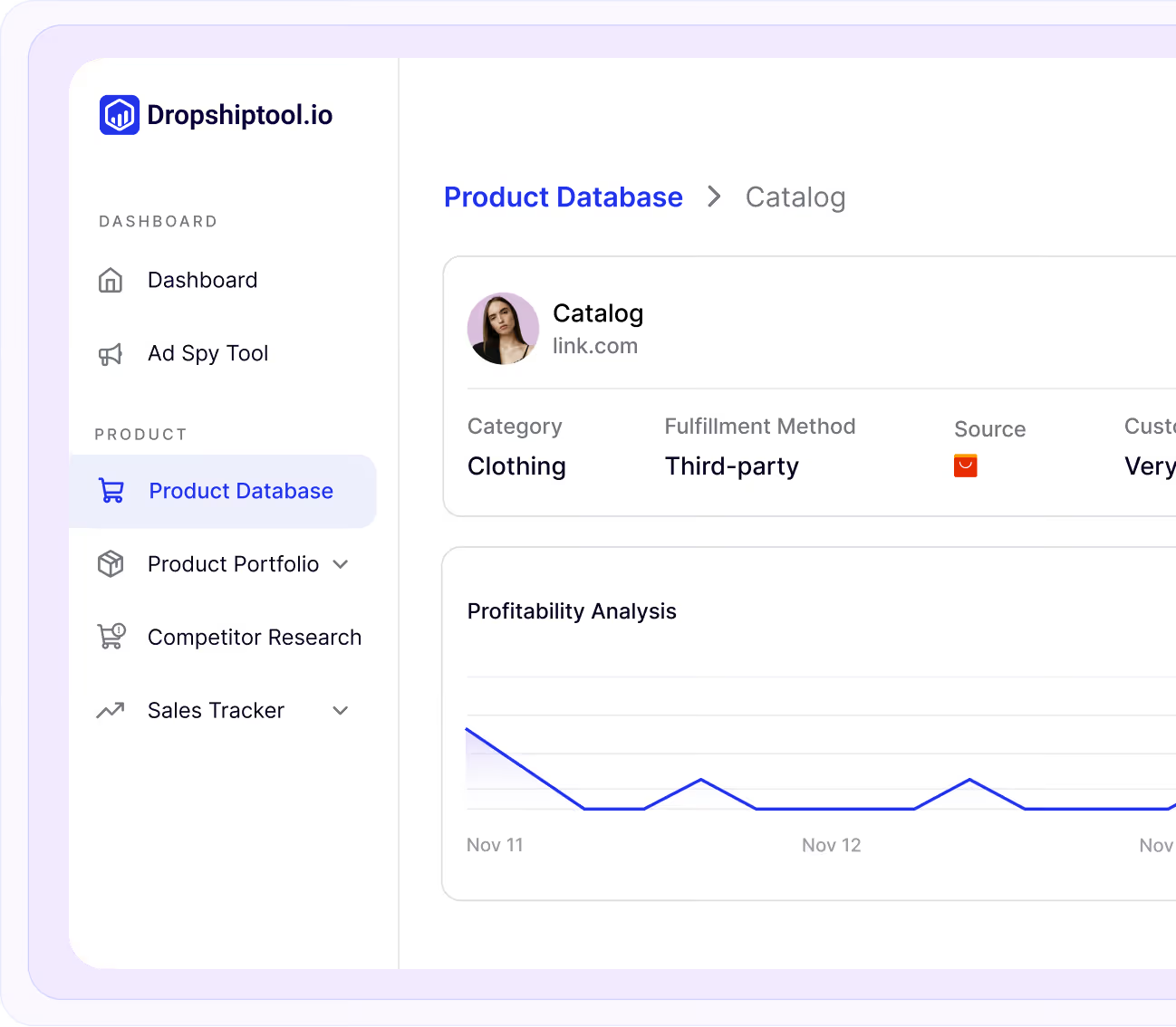
- Product Database: search products by sales, price, category and store count.
- Winning products: items already selling profitably, with room for new stores.
- Trending products: products picking up speed before they saturate.
- Sales Tracker: follow any Shopify store's daily sales and see which products drive them.
- Ad Spy: see which Facebook and TikTok ads are running and for how long.
- Weekly Product Portfolio: a curated list of winners, delivered every week.
Find two or three products with rising sales, check the ads behind them, then source from Spocket or AliDrop and run your test. That's a weekend of work, not a month of guessing.
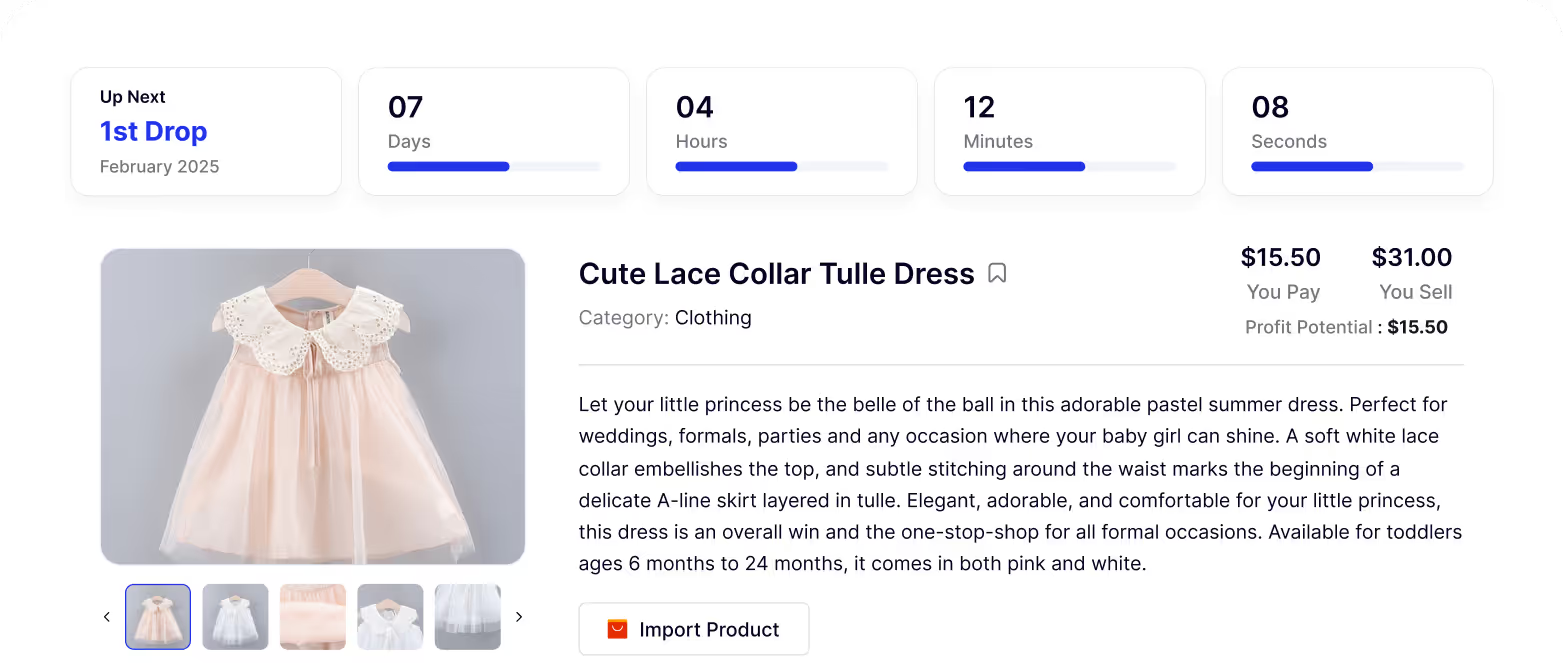
Weekly Drops delivers curated products with demand and margin potential. so you can stay ahead of trends and keep testing new winners.

Trusted by Dropshippers Building Profitable Stores

Dropshiptool is fantastic! It simplified product research and helped me find winning items quickly. Highly recommend it for boosting your dropshipping business!

Great tool for beginners and pros alike. The features are intuitive and useful, though the database could update faster. Still, it’s worth using!

Excellent app! The competitor analysis and profit tracking features are spot-on. It’s a must-have for serious dropshippers.

Dropshipping FAQs
Quick answers to the questions new dropshippers ask most.
What is dropshipping?
How does dropshipping work?
How much money do I need to start dropshipping?
Is dropshipping profitable in 2026?
Is dropshipping legal?
How do I start dropshipping with no experience?
Is there a free trial?

The Most Powerful, All-in-One Spy Tool.