What Is Ecommerce? Definition, Types and Examples (2026)

Ecommerce (electronic commerce) is buying and selling goods or services over the internet, with the order and payment happening online. That's the whole ecommerce definition. It covers a teenager selling sneakers on Depop, a factory taking wholesale orders through a B2B portal, a Shopify dropshipping store, and a streaming subscription. If money changes hands through a website, app or marketplace, it's ecommerce.
This guide explains what ecommerce is in practical terms: the main types (B2C, B2B, C2C, D2C, C2B), the business models people actually run, real examples, how big the market is in 2026, the honest pros and cons, and the steps to start your own ecommerce business.
What is ecommerce? A plain-English definition
Think of ecommerce as retail with the shop counter replaced by a checkout page. A customer finds a product (through search, social media, an ad or a marketplace), adds it to a cart, pays online, and the seller delivers it by post, courier or download. Everything else, from inventory to customer service, is the same work a physical shop does, just organized differently.
A few terms that get mixed up:
- Ecommerce website: the online store itself, built on a platform like Shopify, WooCommerce or BigCommerce.
- Ecommerce business: the company behind it, including suppliers, marketing, fulfillment and customer service.
- E-business: a broader term for any business process run online, including things that aren't sales, like HR software or online banking.
- Online marketplace: a platform where many sellers list products, such as Amazon, eBay, Etsy or Walmart Marketplace.
How ecommerce works, step by step
Every online order follows roughly the same path, whether it's a $9 phone case or a $9,000 pallet of stock:
- Discovery. The shopper finds the product through Google, a TikTok or Facebook ad, an influencer, email or a marketplace search.
- Checkout. They add it to a cart and pay by card, a digital wallet (Apple Pay, Google Pay, Shop Pay, PayPal) or buy now, pay later services like Klarna and Afterpay.
- Payment processing. A payment gateway authorizes the card, takes a fee (usually a percentage plus a fixed amount per transaction) and settles the money to the seller's account a few days later.
- Fulfillment. The seller, a warehouse (3PL) or a dropshipping supplier picks, packs and ships the order and sends tracking.
- After the sale. Delivery confirmation, support tickets, returns, reviews and, ideally, a repeat purchase.
If you want the full order flow for a store that doesn't hold stock, our breakdown of how dropshipping orders work walks through each handoff.
The 5 main types of ecommerce
The answer to "what is ecommerce" looks different depending on who is selling to whom, so types of ecommerce are grouped that way. Most guides list three (B2C, B2B, C2C); in 2026 it's more useful to know five.
| Type | Who sells to whom | Examples | Typical order |
|---|---|---|---|
| B2C | Business to consumer | Amazon, Walmart.com, Best Buy, most Shopify stores | Small, frequent, card payment |
| B2B | Business to business | Alibaba, Grainger, Faire, wholesale portals | Large, recurring, invoices and net terms |
| C2C | Consumer to consumer | eBay, Etsy, Facebook Marketplace, Depop, Vinted | One-off, used or handmade items |
| D2C | Brand direct to consumer | Warby Parker, Allbirds, Gymshark | Brand-owned site, no retailer in between |
| C2B | Consumer to business | Upwork freelancers, Adobe Stock contributors, influencers | Individuals selling services or content to companies |
B2C (business to consumer)
The type most people picture. A business sells finished products to individual shoppers. Order values are low, decisions are fast and marketing does most of the heavy lifting. Most dropshipping and print-on-demand stores are B2C.
B2B (business to business)
Companies selling to other companies: raw materials, parts, office supplies, software, wholesale stock. Orders are bigger, buyers expect volume pricing and payment terms, and relationships last years. Platforms like Alibaba sit here, which is why so many store owners source from it. Some sellers do both B2C and B2B from one store, with a separate wholesale price list.
C2C (consumer to consumer)
Individuals selling to individuals through a platform that takes a fee and handles trust (payments, ratings, disputes). eBay started as exactly this in 1995. It's the easiest way to try selling online, and it's how many full-time sellers started. If you're curious, our list of lesser-known websites to make money includes several C2C marketplaces with lower fees than eBay.
D2C (direct to consumer)
D2C is B2C where the brand that makes (or designs) the product also sells it, skipping wholesalers and retail shelves. The brand keeps the retail margin and owns the customer data, but pays for every visitor with ads or content. Plenty of brands started D2C and then moved into retail once demand was proven.
C2B (consumer to business)
The reverse of the usual flow: individuals sell to companies. Freelancers on Upwork, photographers licensing images, creators paid for sponsored posts and affiliates earning commission all fit here.
You'll also see B2G (business to government, such as public procurement portals) and social commerce (selling directly inside TikTok Shop, Instagram or Facebook) listed as separate types. Social commerce is really a sales channel rather than a type, but it's growing fast enough to deserve its own mention.
Ecommerce business models
The "type" tells you who the customer is. The business model tells you how you get the product to them and where the money comes from. These are the models you'll actually choose between when starting out.
| Model | How it works | Upfront cost | Margin | Main risk |
|---|---|---|---|---|
| Dropshipping | Supplier ships directly to your customer; you never touch stock | Low | Lower per order | Ad costs, shipping times, supplier quality |
| Wholesale and warehousing | Buy stock in bulk, store it, ship it yourself or via a 3PL | High | Higher | Unsold inventory |
| Print on demand | Your designs printed on products only after someone orders | Low | Medium | Thin margins on cheap items, design copying |
| Private label and manufacturing | Your brand on a product made for you | High | Highest | Minimum order quantities, cash tied up |
| Subscription | Recurring delivery or access for a monthly fee | Medium | Medium to high | Churn |
| Digital products | Ebooks, templates, courses, software, downloads | Very low | Very high | Piracy, need for an audience |
Dropshipping is the most common way to start because you don't buy stock until a customer has already paid you. We cover it in depth in what dropshipping is and how it works. The trade-off is margin; see our dropshipping vs wholesale comparison for when holding stock makes more sense.
Print on demand suits designers and anyone with a following. Subscriptions (coffee, pet food, razors, software) win on predictable revenue. Digital products have no shipping at all, which is why many creators add them alongside a physical store.
Examples of ecommerce you already use
If you still want a concrete picture of what ecommerce is, look at your last few purchases:
- Ordering groceries from Walmart or Instacart for delivery (B2C).
- A Shopify dropshipping store selling pet accessories, shipped by a supplier in the US or China (B2C, dropshipping model).
- A coffee subscription that charges your card every month (B2C, subscription model).
- A restaurant ordering napkins and takeout boxes from a wholesale site (B2B).
- Selling your old phone on Swappa or a jacket on Vinted (C2C).
- Buying a Canva template or an online course (digital products).
- A freelance designer invoicing a company through Upwork (C2B).
A short history of ecommerce
Ecommerce is older than most people think. Businesses were exchanging orders electronically through EDI (electronic data interchange) in the 1970s. In 1979, English inventor Michael Aldrich connected a TV to a computer over a phone line and called it "teleshopping." France's Minitel let people order goods through a terminal in the 1980s.
The moment usually cited as the first secure online retail sale came on August 11, 1994, when a man in Philadelphia bought a Sting CD from NetMarket using encrypted card details, a story covered by The New York Times. Amazon launched as an online bookstore in 1995 and eBay (then AuctionWeb) the same year. PayPal followed in 1998. Amazon Prime arrived in 2005 and made fast, free shipping the expectation. Shopify launched in 2006 and made it possible for anyone to open a store without a developer. Since then, the big shifts have been mobile shopping, marketplaces from China (AliExpress, Temu, Shein), social commerce and, most recently, AI shopping assistants that help people research and compare products.
How big is ecommerce in 2026?
Big, and still growing faster than retail overall.
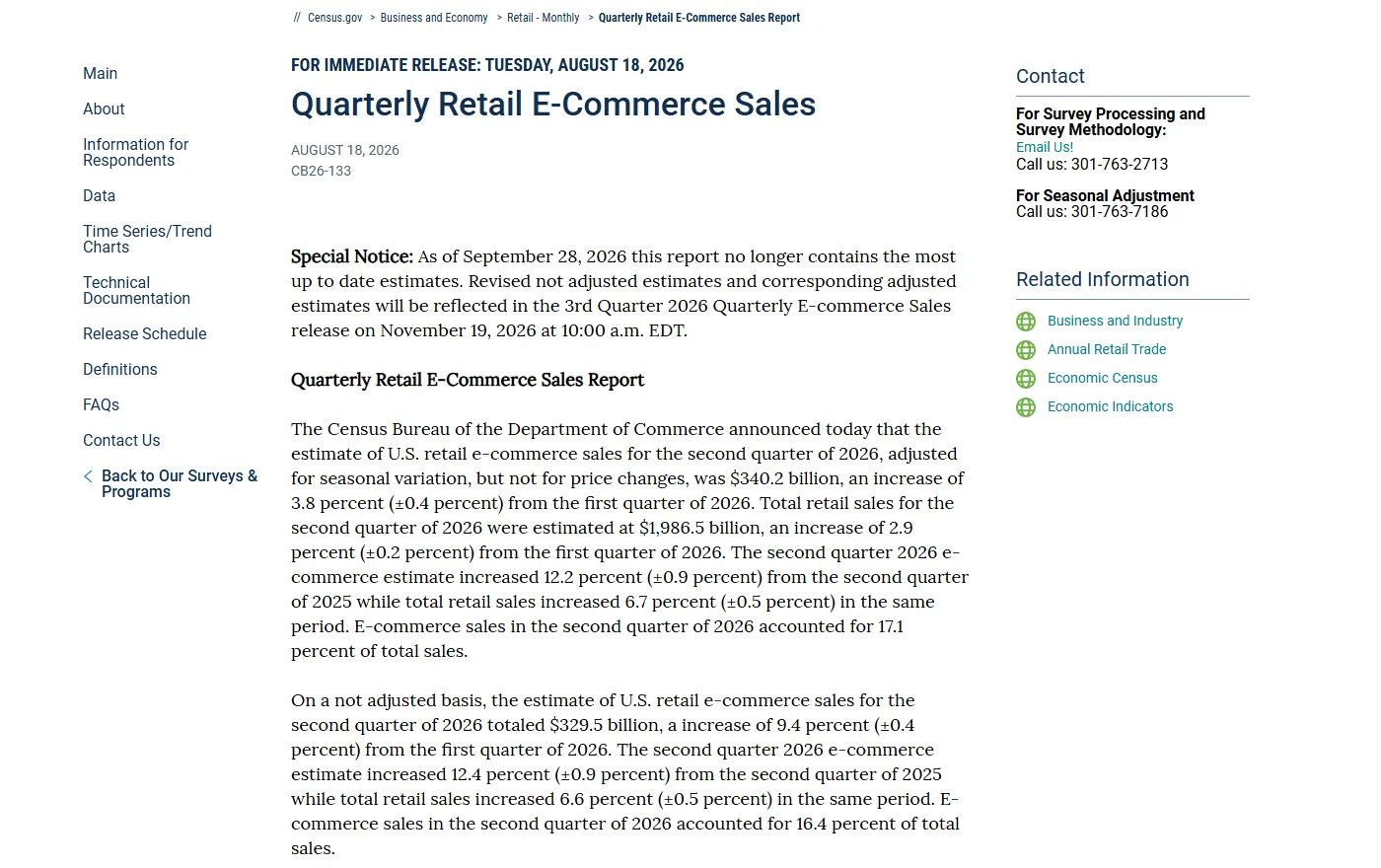
- United States: the US Census Bureau estimated retail ecommerce sales at $340.2 billion in the second quarter of 2026 (seasonally adjusted), up 12.2% on the same quarter of 2025, while total retail grew 6.7%. Ecommerce made up 17.1% of all US retail sales.
- Worldwide: EMARKETER's forecast, as published in Shopify's global ecommerce report, puts worldwide retail ecommerce at about $6.42 trillion in 2025 and $6.88 trillion in 2026, roughly 21% of all retail sales.
- Returns: the NRF's 2025 Retail Returns Landscape estimated that 19.3% of online sales would be returned in 2025, compared with 15.8% across all retail. That gap is the hidden cost of selling online.
Note the gap between US growth (12.2% year over year) and total retail (6.7%). Shoppers are still moving online, even in a mature market.
Advantages of ecommerce
- Low startup cost. A store on a hosted platform costs a monthly subscription, not a lease. With dropshipping or print on demand you don't need inventory either.
- A national or global market from day one. A shop in a small town sells to its town. An online store can sell anywhere its shipping reaches.
- Open 24/7. Orders come in while you sleep, especially when you sell across time zones.
- Data on everything. You can see which ad brought each customer, where shoppers drop off and which products earn repeat orders. A physical shop can only guess.
- Easy to test. You can launch a product page in an afternoon, run $50 of ads and know within days whether anyone cares.
Disadvantages of ecommerce
- Competition is one click away. Shoppers compare prices in seconds, and someone will always undercut you on a commodity product.
- Paying for attention. You don't get foot traffic. Every visitor comes from ads, SEO, social content or email, and ad costs rise every year.
- Shipping and returns. Delivery delays, lost parcels and that 19% online return rate all eat into margin.
- No touch or try-on. Customers can't feel fabric or test fit, so product photos, videos and reviews carry the sale.
- Fraud and chargebacks. Card fraud, "item not received" claims and return abuse are part of the job.
- Rules you must follow. Sales tax or VAT collection, consumer protection, data privacy and accessibility apply online too.
Legal and compliance basics
Every country is different, but most new sellers need to handle the same short list: register the business (sole proprietor or LLC is fine at first), collect sales tax or VAT where you're required to, publish a privacy policy, refund policy and terms of service, and ship within the time you promise. In the US, the FTC's Mail, Internet, or Telephone Order Merchandise Rule requires you to ship when you say you will (or within 30 days if you don't say) and to offer a refund if you can't.
How to start an ecommerce business in 8 steps
- Pick a niche with proven demand. Don't start from what you like; start from what people already buy. Look at what existing stores sell and how often. Our guide on choosing a niche has a simple scoring method.
- Choose a business model. Dropshipping or print on demand if cash is tight, wholesale or private label if you can afford stock and want higher margins.
- Validate products before you build anything. Check that real stores are getting sales on similar items, that the product can sell for at least 2.5 to 3 times its landed cost, and that it isn't already flooded with copycats.
- Find suppliers. For dropshipping, Spocket covers US and EU suppliers with faster delivery, and AliDrop connects AliExpress to Shopify. Order samples before you advertise anything.
- Build the store. Choose a platform (see below), a clean theme, clear product pages, shipping and returns policies, and a working checkout. Place a test order yourself.
- Set up payments, tax and analytics. Connect a payment provider, turn on tax collection where required, and install analytics and ad pixels before you spend on traffic.
- Drive traffic. Most new stores start with paid social (TikTok and Meta ads) or short-form organic video, then add email and SEO over time.
- Measure, cut and scale. Track profit per order, not revenue. Kill products that don't hit break-even within a set budget and put more behind the ones that do. Our article on how much dropshippers make shows the margin math with real numbers.
Where Dropshiptool fits
Steps 1 and 3 are where most new stores fail: they guess at products instead of checking what's already selling. Dropshiptool's Product Database lets you filter products by niche, price and sales trend, and the Sales Tracker shows estimated daily revenue for real Shopify stores, so you can see whether a product is rising, peaking or fading before you build around it. You can start with a free Dropshiptool account and browse what's trending in your niche this week.

Ecommerce platforms compared
Your platform is the software your store runs on. For most beginners the choice comes down to these:
| Platform | Best for | Watch out for |
|---|---|---|
| Shopify | Dropshipping, D2C brands, anyone who wants it to just work | App costs add up; extra fee if you don't use Shopify Payments |
| WooCommerce | WordPress users who want full control | You handle hosting, security and updates |
| BigCommerce | Larger catalogs and B2B features | Plan limits tied to annual sales |
| Wix and Squarespace | Small catalogs alongside a portfolio or service site | Fewer ecommerce apps and integrations |
| Marketplaces (Amazon, eBay, Etsy, TikTok Shop) | Instant access to buyers | Higher fees, strict rules, you don't own the customer |
We compare them in more depth in our roundup of ecommerce website building platforms, and if you're leaning toward Shopify, start with what Shopify is and how it works.
Ecommerce trends worth watching in 2026
- Social commerce. TikTok Shop and Instagram checkout let people buy without leaving the app, which shortens the path from video to sale.
- Mobile first. Most store traffic is now on phones, so a slow or clunky mobile checkout quietly costs you sales every day.
- AI in the workflow. Sellers use AI for product descriptions, ad variations and customer support, and shoppers increasingly use AI assistants to research products before they buy.
- Faster local shipping. Buyers expect delivery in days, not weeks, which is pushing dropshippers toward US and EU suppliers.
- Returns getting stricter. With online returns near one in five orders, more stores are charging for returns or offering exchanges and store credit first.
The bottom line
What is ecommerce in one line? Selling online, with all the same fundamentals as any shop: a product people want, a fair price, reliable delivery and good service. The barrier to starting has never been lower. The barrier to standing out has never been higher, which is why the sellers who win spend their time on product research and customer experience rather than store design. If you're ready to look for your first product, sign up for Dropshiptool and see what real Shopify stores are selling right now.