How Much Do Dropshippers Make in 2026? Real Margin Math

Most dropshippers make little or nothing in their first few months, and many lose a few hundred dollars testing products. The ones who find a product that works typically keep 10% to 30% of revenue as net profit after product costs, ads and fees. In real money, that means a store doing $12,000 a month in sales might clear around $3,000, and a store doing $70,000 might clear $10,000 to $15,000. How much dropshippers make comes down to one equation: what's left of each order after the supplier, the ad platform and the payment processor have taken their cut.
This guide shows that equation with real numbers: a per-order breakdown, three monthly scenarios from first test to scaled store, the factors that move dropshipping income up or down, a realistic timeline, and how to estimate what a competitor's store actually earns.
How much do dropshippers make? The short answer
There's no official survey of dropshipping income, and screenshots of Shopify dashboards on social media show revenue, not profit. So treat any single "average salary" figure with suspicion. What we can say from the margin math below, and from what operators report:
| Stage | Typical monthly revenue | Typical monthly net profit | What's happening |
|---|---|---|---|
| Testing (months 1 to 3) | $0 to $2,000 | Loss of $200 to $1,000 | Testing products and ads, most fail |
| First winner | $5,000 to $20,000 | $1,000 to $5,000 | One or two products profitable, learning to scale |
| Established store | $50,000 to $150,000 | $8,000 to $30,000 | Multiple products, steady ad spend, margins squeezed by scale |
Those are ranges built from the worked examples in this article, not a promise. Plenty of stores never leave the first row. Industry blogs commonly quote 10% to 30% net margins for dropshipping once ads are included, which matches the math below.
Dropshipping profit per order: a worked example
Let's take a typical mid-priced product: a posture corrector, a pet grooming glove, a phone accessory. You sell it for $39.99 with free shipping. Here's where the money goes.
| Line | Amount | Notes |
|---|---|---|
| Sale price | $39.99 | What the customer pays |
| Product + shipping from supplier | -$11.00 | Landed cost to the customer's door |
| Payment processing | -$1.46 | 2.9% + $0.30, the standard US online card rate on Shopify Payments Basic |
| Refunds and chargebacks allowance | -$1.60 | 4% of revenue set aside |
| Ad cost per purchase (CPA) | -$15.00 | What Meta or TikTok charges, on average, to get one sale |
| Profit per order | $10.93 | 27% of the sale price, before monthly fixed costs |
Notice how small the supplier cost looks next to the ad cost. That's normal. For most paid-ads stores, the single biggest expense is acquiring the customer, not the product.
Now the scary part. If your CPA rises from $15 to $28 (a tired creative, a rising CPM in Q4, a competitor copying your ad), the same order loses $2.07. Nothing about the product changed. That's why experienced dropshippers obsess over their break-even point.
Your break-even CPA and ROAS
Take the sale price and subtract every cost except ads: $39.99 - $11.00 - $1.46 - $1.60 = $25.93. That's your break-even CPA. Spend more than $25.93 in ads to get a sale and you lose money on it. Divide the price by that number ($39.99 / $25.93) and you get a break-even ROAS of about 1.54. Anything above 1.54 in Ads Manager is profit; below it, you're paying customers to shop with you. Our guide to ROAS vs break-even ROAS goes deeper, and you can plug your own numbers into the dropshipping profit margin calculator.
Dropshipping income per month at three different scales
Per-order profit only tells half the story. Monthly costs (Shopify plan, apps, domain, tools, a virtual assistant later on) come off the top, and ad costs behave differently at different spend levels. Here are three months that look a lot like real stores.
Scenario 1: the testing month
You test five products with $120 of ads each ($600 total). Four flop. One gets some sales. You end up with 15 orders, an effective CPA of $40 across the whole test, and about $100 in apps and plan fees.
- Revenue: 15 × $39.99 = $599.85
- Product costs: $165.00
- Payment fees: $21.90
- Refund allowance: $23.99
- Ads: $600.00
- Fixed costs: $100.00
- Net: -$311.04
This is what most first months look like. You haven't failed; you've paid $311 to learn which four products not to sell. The mistake is quitting here or, worse, scaling the "winner" before the data is clear.
Scenario 2: one product working, 10 orders a day
You've found a product that converts and your CPA has settled at $15. You're doing 300 orders a month with $300 in fixed costs (plan, apps, a research tool).
- Revenue: 300 × $39.99 = $11,997
- Product costs: $3,300
- Payment fees: $437.91
- Refund allowance: $479.88
- Ads: $4,500
- Fixed costs: $300
- Net: $2,979.21 (24.8% net margin)
That's a solid side income from a single product. Note that you spent $4,500 on ads to make $2,979. You need that cash available before the sales money settles, which is a real constraint for beginners.
Scenario 3: scaling to 50 orders a day
Scaling raises CPA, because you've exhausted the cheapest audiences. Say it climbs to $20. You add bundles and upsells, lifting average order value to $47 and landed cost to $13 per order. Fixed costs grow to $2,500 (more apps, a customer service VA, creative production).
- Revenue: 1,500 × $47 = $70,500
- Product costs: $19,500
- Payment fees: $2,494.50
- Refund allowance: $2,820
- Ads: $30,000
- Fixed costs: $2,500
- Net: $13,185.50 (18.7% net margin)
Margin percentage went down while profit in dollars went up four times. That pattern is normal. Stores that scale profitably accept a thinner margin in exchange for volume, then claw some back through better supplier pricing and email or SMS repeat sales that cost nothing in ads. For the operational side of growing, see how to scale a dropshipping business.
What typical dropshipping margins look like
Two different margins get confused all the time:
- Gross margin (price minus product and shipping cost): usually 50% to 75% for paid-ads dropshipping. In the example above it's 72%. You need it high because ads will take a big slice.
- Net margin (after ads, fees, refunds and overheads): commonly 10% to 30% for a healthy store. Under 10% leaves no cushion for a bad week; over 30% usually means organic traffic or a very high-ticket product.
A simple pricing rule many sellers use: sell at least 2.5 to 3 times your landed cost. At 2x, there's rarely enough room left for ads. Our post on the true cost of running a dropshipping business lists the smaller fees (currency conversion, chargeback fees, app creep) that quietly eat a few points of margin.
Factors that change how much dropshippers make
Average order value
Ad platforms charge roughly the same to get a click whether you sell a $20 or a $60 product. Higher-priced items and bundles leave more room after the CPA. This is why "cheap impulse buys" are hard to make profitable with paid ads in 2026.
Ad costs and creative quality
Your CPA depends on CPM (what you pay per 1,000 impressions), click-through rate and conversion rate. Fresh, native-looking video creatives are the biggest lever you control. CPMs also climb in Q4 as big brands flood the auctions, so November margins often look worse than September's even with higher sales.
Conversion rate
Littledata's widely cited Shopify benchmark puts the typical store conversion rate around 1.4%. Moving from 1.4% to 2% on the same traffic cuts your CPA by about 30%. Faster pages, clear shipping times, reviews with photos and a simple checkout all count.
Returns and refunds
The NRF's 2025 Retail Returns Landscape estimated 19.3% of online sales would be returned in 2025. Dropshippers often refund rather than accept returns of low-cost items, but apparel and anything with sizing will run well above the 4% allowance used above. Budget by category, and write a clear returns policy before your first sale.
Supplier and shipping speed
Two-week delivery means more "where's my order" tickets, more chargebacks and fewer repeat buyers. Suppliers with US or EU warehouses, like those on Spocket, usually cost a little more per unit but protect margin further down the line. If you source from AliExpress, AliDrop handles the import and order routing into Shopify.
Taxes
Profit isn't take-home pay. In the US, on top of income tax, the self-employed owe self-employment tax of 15.3% on net earnings. Many states also require you to collect sales tax. Set aside a chunk of every month's profit so April doesn't wipe out the year.
How long until a dropshipping store makes money?
Asking how much dropshippers make is only half the question; the other half is how long it takes. There's no data set on this either, but the pattern among stores that succeed is consistent:
- Weeks 1 to 4: store setup, first product tests. Expect to be negative.
- Months 2 to 3: more tests, better creatives, first product that hits break-even or slightly above.
- Months 3 to 6: a consistent winner and the first profitable months, usually a few hundred to a few thousand dollars.
- Months 6 to 12: adding products, email flows and a second ad channel. This is when income can start to look like a salary.
Budget for three months of testing before judging the business. Sellers who start with $300 total and expect profit in week two almost always quit. If you're still deciding whether to start at all, our honest take on whether dropshipping is worth it in 2026 covers the trade-offs.
How to estimate a competitor store's revenue
The fastest way to know how much dropshippers make in your niche is to look at stores already doing it. Revenue estimates won't give you their profit, but they show what demand exists and whether a product is growing or dying.
Method 1: use a sales tracker
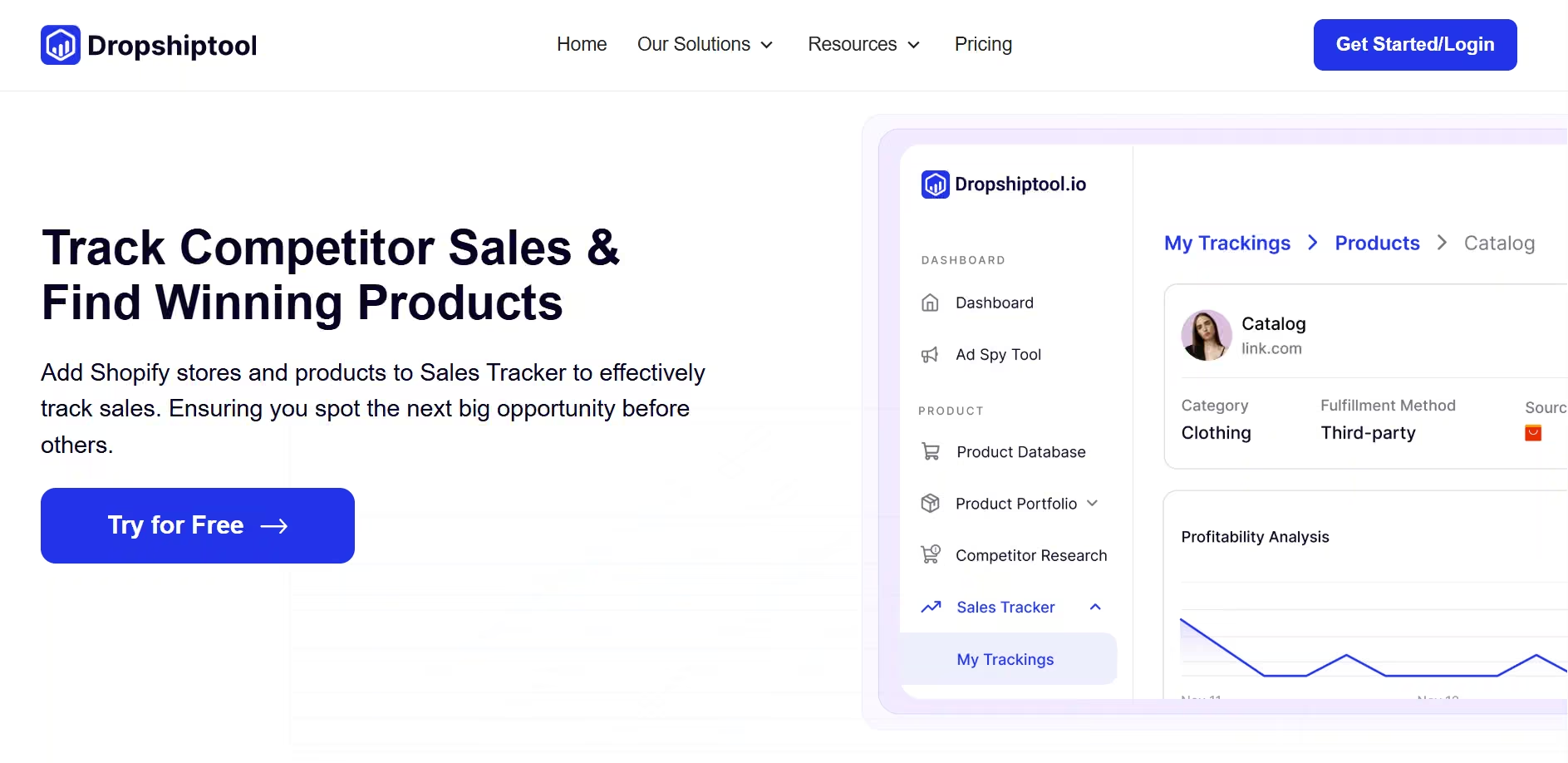
Dropshiptool's Sales Tracker monitors Shopify stores and estimates their daily sales and revenue, plus which products are driving them. Add a few competitors, check back after a week, and you'll see their best sellers, price changes and new launches. It's the closest thing to looking over their shoulder. You can track a few stores free before deciding on a product.
Method 2: traffic times conversion times AOV
Take a store's estimated monthly visits from a traffic tool, multiply by a conversion rate assumption (1% to 2%), then by its typical order value. A store with 50,000 visits, 1.5% conversion and a $45 AOV does roughly 50,000 × 0.015 × $45 = $33,750 a month. It's rough, but good enough to tell a $5,000 store from a $100,000 one.
Method 3: check their ads
The Meta Ad Library shows every active ad a page is running. A store running 40 active creatives for three months is spending real money, and nobody keeps spending on ads that lose. Pair that with an ad spy tool to see which creatives have been live longest.
Method 4: watch review and stock signals
Steady growth in product reviews, "only 3 left" counters that actually change, and frequent restocks all hint at volume. None is reliable alone; together with tracker data they build a clear picture. Our guide on how to check Shopify store sales walks through each method in more detail.
Ways to make more per order
- Raise AOV with bundles and quantity breaks. "Buy 2, save 15%" lifts order value with almost no extra ad cost.
- Build an email and SMS list from day one. Repeat buyers cost nothing to acquire. A welcome flow, abandoned cart and post-purchase sequence are the minimum.
- Renegotiate supplier pricing at volume. Once you're doing 30+ orders a day, ask for a better unit price or move to a private agent.
- Test prices. A $5 price increase drops straight to profit if conversion barely moves, which happens more often than people expect.
- Kill losers fast. Set a test budget per product (for example, 2x your break-even CPA with no sale) and stick to it.
The honest answer
How much do dropshippers make? Somewhere between "lost a few hundred dollars and quit" and "clears five figures a month," with most landing at the low end because they stop before the testing phase pays off. The difference between the two groups is rarely luck. It's knowing your break-even numbers, choosing products with proven demand, and treating ad spend as a test budget rather than a lottery ticket. If you want to start with products that are already selling instead of guessing, create a free Dropshiptool account and look at what real stores in your niche are earning. New to selling online? Start with our explainer on what ecommerce is.