Best Dropshipping Niches for 2026: 12 Picks and How to Choose

The best dropshipping niches for 2026 are pet supplies, beauty and personal care tools, home fitness and recovery, home office and desk setups, smart home and lighting, kitchen and home organisation, baby and parenting, car accessories, outdoor and hobby gear, sleep and wellness, travel accessories and sustainable home goods. Each has steady year-round demand, room for a healthy markup and products light enough to ship cheaply.
A good category is only half the job, though. Two stores in the same niche can get completely different results depending on which sub-niche they pick and how they test it. Below you'll find the 2026 list with a comparison table, a simple scoring system to evaluate any niche, the niches to avoid, and how to validate your pick with real sales data before you spend on ads.
Best dropshipping niches for 2026 at a glance
| Niche | Typical retail price | Margin potential | Shipping difficulty | Repeat purchases | Competition |
|---|---|---|---|---|---|
| Pet supplies | $15 to $80 | High | Low | High | High (go narrow) |
| Beauty and personal care tools | $20 to $150 | High | Low | Medium to high | High |
| Home fitness and recovery | $25 to $200 | Medium to high | Medium | Low to medium | Medium |
| Home office and desk setup | $20 to $150 | Medium to high | Low to medium | Low | Medium |
| Smart home and lighting | $20 to $120 | Medium | Low | Low | Medium to high |
| Kitchen and home organisation | $15 to $70 | Medium | Low to medium | Medium | High |
| Baby and parenting | $20 to $120 | Medium to high | Low | Medium | Medium |
| Car accessories and care | $15 to $90 | High | Low | Medium | Medium |
| Outdoor, camping and golf | $20 to $200 | Medium to high | Medium | Low to medium | Low to medium |
| Sleep and wellness | $20 to $120 | High | Low | Medium | Medium |
| Travel accessories | $15 to $100 | Medium to high | Low | Low | Medium |
| Sustainable home goods | $15 to $60 | Medium | Low | High | Low to medium |
These are broad categories. If you want smaller, high-margin corners with less competition, such as reptile climate control or archery tuning tools, see our list of the 30 most profitable dropshipping niches. That post is about micro-niches. This one is about the big categories most stores should start from.
How to evaluate a dropshipping niche (a 5-point scorecard)
Before committing to any niche, score it from 1 to 5 on each of these five factors. If it scores 15 or less out of 25, skip it. Anything over 20 deserves a real product test.
1. Demand: are people searching and buying every month?
Open Google Trends, set it to five years and your target country, and look at the shape. A flat or slowly rising line is what you want. A single huge spike that falls back usually means a fad. Seasonal waves are fine as long as you know when they come. Then check whether products in the niche are selling right now. Amazon's Best Sellers pages and Dropshiptool's Sales Tracker show real buying, not just interest.
2. Competition: can a new store win a share?
Search your main keywords and look at the first page of Google and the Meta Ad Library. Lots of competitors is fine. It proves the money is there. What you want to know is whether they're beatable. Weak branding, supplier photos, slow shipping and bad reviews are all openings. A niche owned by a few loved brands with loyal customers (think high-end coffee machines) is much harder.
3. Margin: is there room after ads?
Aim for products you can sell at around 2.5 to 3 times landed cost, with a retail price of $25 or more. Below $20 there's rarely enough left after payment fees and ad costs. Our guide to finding high-margin products shows the full calculation.
4. Shipping and logistics: will it arrive intact and on time?
Light, compact, non-fragile items under about 2 kg are easiest. Batteries, liquids, glass and oversized items all add cost, restrictions or breakage risk. Check whether US or EU suppliers carry the products, because faster delivery means fewer refunds.
5. Repeat purchases and lifetime value
Consumables and add-ons (pet treats and toys, skincare refills, filters, replacement heads) bring customers back without paying for a new ad click. A niche with repeat purchases can live with a higher first-order acquisition cost.
Here's how two ideas score:
| Factor | Dog enrichment toys and lick mats | Generic phone cases |
|---|---|---|
| Demand | 4 | 5 |
| Competition | 3 | 1 |
| Margin | 4 | 2 |
| Shipping | 5 | 5 |
| Repeat purchases | 4 | 2 |
| Total | 20 | 15 |
Phone cases have huge demand, but competition and margin kill them for a new store. That's the trap a lot of beginners fall into: picking on demand alone.
The best dropshipping niches in 2026, explained
1. Pet supplies
Pet spending keeps climbing. The American Pet Products Association reports that U.S. pet industry spending reached about $158 billion in 2025 and projects around $165 billion for 2026. Ninety-five million U.S. households own a pet. Supplies, medications and live animals made up about $34.4 billion of that.
The trick is going narrow. “Pet supplies” is too broad to brand. “Enrichment for high-energy dogs”, “cat furniture for small apartments” or “senior dog mobility” give you a clear customer and ad angle. Good sub-niches: lick mats and puzzle feeders, no-pull harnesses, orthopaedic dog beds, cat water fountains and grooming tools. More ideas in our winning pet products guide.
2. Beauty and personal care tools
McKinsey's State of Beauty 2025 puts the global beauty market at about $450 billion. It grew around 7% a year from 2022 to 2024, and McKinsey expects about 5% a year through 2030. For dropshippers, the sweet spot is tools and devices rather than creams you can't control the formula of: LED masks, heatless curlers, scalp massagers, ice rollers, gua sha, nail kits and hair-styling tools. They demo well on video and have strong markups. If you do sell skincare, check ingredient and labelling rules in every country you ship to.
3. Home fitness and recovery
Big machines are a logistics headache. The accessories around them aren't. Massage guns, foam rollers, resistance band sets, adjustable kettlebell handles, compression boots (at the premium end) and mobility tools sell to gym-goers and home trainers alike. Recovery is the growing angle in 2026, with more buyers spending on feeling better than on lifting heavier.
4. Home office and desk setup
Hybrid work is now normal, and people keep upgrading their desks. Monitor risers, cable management kits, under-desk foot rests, laptop stands, desk mats and ergonomic accessories are cheap to ship and easy to bundle. Content about “desk setups” does very well on TikTok and YouTube Shorts, which gives you free creative ideas.
5. Smart home and lighting
Motion-sensor lights, smart plugs, LED strip kits, sunrise alarm clocks and rechargeable wall lights sell year round, with a bump before the holidays. Pick products that work with common ecosystems and don't need complicated setup, because install problems turn into refunds.
6. Kitchen and home organisation
Drawer organisers, fridge storage, spice racks, vacuum storage bags and under-sink organisers. It's competitive, so win on angle (small apartments, RV kitchens, renters) and bundles rather than single items.
7. Baby and parenting
New parents are time-poor, motivated and buy online. Feeding accessories, white-noise machines, nursery organisers, car-seat accessories and travel gear are good starters. Avoid anything that needs safety certification you can't verify, such as cribs and car seats themselves.
8. Car accessories and care
Detailing kits, seat-gap organisers, phone mounts, trunk organisers, portable vacuums and dash cams. Margins are good because car owners already spend money on their cars without thinking twice, and many items are consumables (cleaning products, microfibre towels).
9. Outdoor, camping and golf
Less crowded than the categories above. Camping lighting, compact cookware, hammocks, golf training aids, rangefinder accessories and fishing organisation sell to hobbyists who spend heavily on their passion. Expect strong seasonality in spring and summer.
10. Sleep and wellness
Weighted sleep masks, mouth tape, silk pillowcases, blue-light glasses, white-noise devices and acupressure mats. Sleep is a problem people will pay to fix. Keep claims modest. “Helps you relax” is fine. “Cures insomnia” is not.
11. Travel accessories
Packing cubes, tech organisers, neck pillows, luggage scales, travel bottles and anti-theft bags. Travel spending is steady and these products have clear before-trip buying moments you can target.
12. Sustainable home goods
Reusable food wraps, refillable cleaning kits, bamboo kitchen tools and compostable bin bags. Repeat buying is built in, and buyers in this niche care about brand values more than the lowest price.

Dropshipping niches to avoid
- Overcrowded generic gadgets. Phone cases, basic earbuds and random “viral” kitchen tools have thousands of identical listings. You'll compete on price and lose.
- Regulated health products. Supplements, medical devices and anything making treatment claims need certifications and labelling most dropshipping suppliers can't provide. Chargebacks and platform bans follow.
- Fragile or bulky items. Large glass decor, heavy furniture and anything needing assembly by a professional. A few broken deliveries wipe out a month's profit.
- Branded or licensed goods without permission. Sports jerseys, character merchandise and designer lookalikes get seized and taken down. Sell unbranded products or genuine stock you're authorised to resell.
- Pure fads. If the Google Trends line looks like a single spike, you're probably late.
Matching a niche to your budget
Your starting budget should shape your niche as much as demand does.
- Under $1,000: stick to low-ticket, light products ($20 to $40) in pet, car, desk and kitchen niches. You can test several products cheaply and learn fast. Organic TikTok content helps stretch the budget.
- $1,000 to $3,000: beauty tools, sleep and wellness, and home fitness accessories open up. You can afford samples, your own product videos and a proper ad test per product.
- $3,000 and up: higher-ticket niches like premium outdoor gear, walking pads or luxury accessories become realistic. Fewer sales, more profit per order, and you'll need a longer test period because buyers take longer to decide. Our luxury products to dropship guide covers that end of the market.
Broad niche or sub-niche?
Go narrow for the first store. “Fitness” is a category. “Recovery tools for runners” is a niche. The narrow version gives you a clear customer for ad targeting, easier product research and a brand that people remember. You can widen later. Most successful stores start with 10 to 20 products in one sub-niche and add adjacent products once they know what their customers buy.
A practical way to find sub-niches is to look at stores that are already winning. If you spot three or four Shopify stores growing fast in “cat furniture for apartments”, that sub-niche is real. Our guide on how to choose a dropshipping niche walks through the full process.
How to validate a niche with Dropshiptool
Here's a quick validation routine that takes an afternoon instead of a month of ad spend:
- Search the niche in the Product Database. Filter by category and price, and count how many products have meaningful sales. A handful of strong sellers is a good sign. Hundreds of identical cheap listings is a warning.
- Find the top stores with Competitor Research. Look at their best sellers, prices and how many products they carry. Note the gaps: bad photos, weak copy, missing bundles.
- Track 5 to 10 of those stores in the Sales Tracker for a week or two. Are sales steady or falling? Steady sales over several weeks tell you more than one viral week.
- Check the ads. The Ad Spy Tool shows which creatives are running in the niche and how long they've been live. Ads that run for months are usually profitable.
- Score the niche with the 5-point scorecard above, then test your three best products with a small budget.
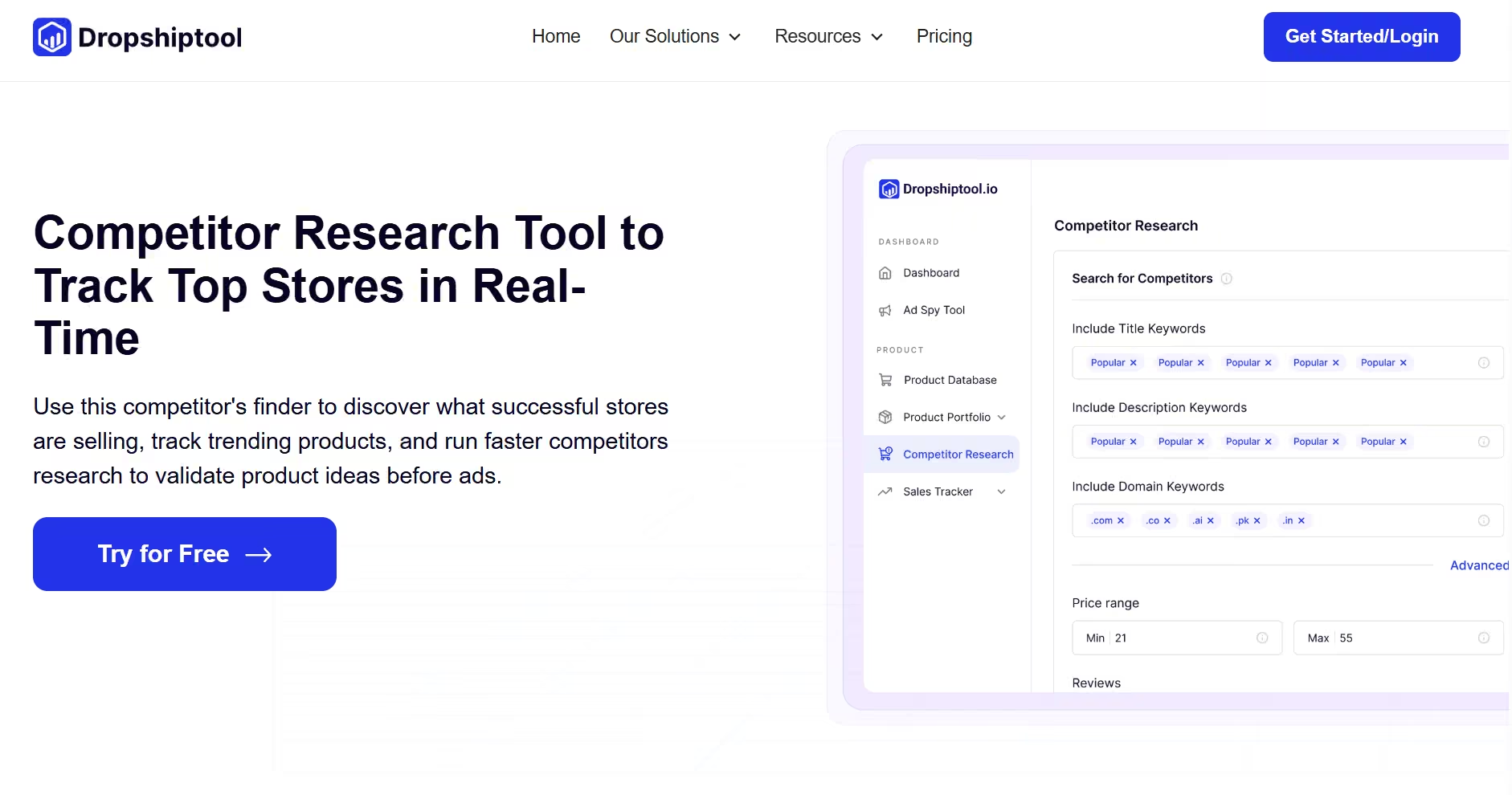
You can run this whole routine with a free Dropshiptool account. Once you've picked a niche, use our trending dropshipping products list to find products to test first, and read how to spot a saturated product before you spend on ads.
Picking your niche
There's no single best dropshipping niche. There's the best one for your budget, interests and skills. Pet supplies, beauty tools, home fitness, desk setups and car accessories are the safest starting points for 2026, because demand is steady and products are easy to ship. Outdoor, sleep, travel and sustainable goods give you less competition if you're willing to build a more specific brand. Whichever you choose, score it honestly, validate it with sales data and start narrow.
Ready to see what's actually selling in your niche? Start with Dropshiptool and check the products, stores and ads behind it before you commit a dollar.