12 Best Dropshipping Suppliers for Shopify in 2026 (Compared)

The best dropshipping suppliers for Shopify in 2026 are the ones that plug straight into your store as an app: Spocket for US and EU suppliers, CJdropshipping and DSers for low-cost China sourcing, Zendrop and AutoDS for automation, Syncee and TopDawg for wholesale-style catalogs, and Printful or Printify for print on demand. Below are 12 options we checked on the Shopify App Store in October 2026, with current pricing and the trade-offs that matter once real orders start coming in.
One note before the list. This guide is about Shopify supplier apps specifically. If you want the broader process (directories, wholesalers, contacting manufacturers directly), read our guide on how to find dropshipping suppliers.
What makes a good dropshipping supplier for Shopify?
Any supplier can ship a parcel. A good Shopify supplier does five things without you babysitting it:
- Syncs inventory and price. If stock runs out at the supplier, the product should go out of stock in your store automatically. Overselling is the fastest way to collect chargebacks.
- Pushes tracking back to Shopify. Customers get shipping emails from your store, and you aren't copying tracking numbers by hand.
- Ships from where your customers are. A US shopper waiting 15 days asks for a refund far more often than one waiting 4.
- Prices transparently. You need product cost plus shipping per destination before you set a retail price, not after the first invoice.
- Answers when things go wrong. Damaged items, lost parcels and wrong variants happen. You want a dispute process that doesn't take three weeks.
Best Shopify dropshipping suppliers compared
Ratings, review counts and prices below come from each app's Shopify App Store listing, checked on 19 October 2026. App prices change often, so confirm on the listing before you subscribe.
| Supplier app | Best for | Rating (reviews) | Starting price | Main supplier base |
|---|---|---|---|---|
| Spocket | Fast US/EU shipping | See listing | Free; paid from $39.99/mo | US, EU and 20+ other countries |
| CJdropshipping | Cheap sourcing + branding | 4.9 (2,896) | Free; optional $15.99/mo | China, plus US/UK/DE warehouses |
| DSers | AliExpress order automation | 5.0 (6,385) | Free; paid from $19.90/mo | AliExpress, 1688 |
| AliDrop | AliExpress, Alibaba and Temu imports | See listing | Free; paid from $39/mo | AliExpress, Alibaba, Temu |
| Zendrop | Branding and packaging | 4.5 (1,275) | $29/mo to link products | US and global |
| AutoDS | Multi-supplier automation | 4.6 (1,328) | $26.90/mo (3-day trial) | AliExpress, Amazon, Walmart, Shein and more |
| Syncee | Large verified supplier network | 4.1 (552) | Free (25 products); paid from $39.99/mo | 25 countries |
| Modalyst | Fashion and name brands | 3.5 (66) | Free; paid from $35/mo | US, Europe, China |
| TopDawg | US wholesale catalog | 5.0 (23) | Free to browse; paid from $49.99/mo | US suppliers |
| Printful | Premium print on demand | 4.8 (3,962) | Free; Growth $24.99/mo | US, EU, Canada, Mexico, Japan, Australia |
| Printify | Low-cost print on demand | 4.7 (4,360) | Free; Premium $39/mo | Global print-provider network |
| Shopify Collective | Selling other Shopify brands | Shopify's own app | Free for eligible stores | Other Shopify stores |

The 12 best dropshipping suppliers for Shopify, reviewed
1. Spocket: best for US and EU suppliers
Spocket's pitch is speed. Most of its catalog comes from suppliers in the US and Europe, so delivery to shoppers in those regions is measured in days rather than weeks. The Spocket listing advertises access to 7+ million products, supplier chat, image search and branded invoicing on the Pro plan. Plans run Free, Starter ($39.99/mo), Pro ($59.99/mo) and Empire ($99.99/mo), each paid tier with a 7-day trial.
The trade-off is unit cost. US-made or US-stocked products cost more, so Spocket works best for products you can sell at $35 and up, where faster delivery pays for itself in fewer refund requests and better reviews. Start on the free plan to test a few products, then move to a paid tier once you know which ones sell. Full details in our Spocket review.
2. CJdropshipping: best for low-cost sourcing and branding
CJ is free to use, has a massive catalog, and will source products it doesn't list yet. It also does custom packaging, POD and warehousing in the US, UK and Germany. Optional memberships ($15.99 to $59.99 a month) mainly add sourcing requests. The weak spot is shipping time for anything sent from China. We cover fees, warehouses and review themes in our CJ Dropshipping review.
3. DSers: best for AliExpress order automation
DSers bills itself as AliExpress's official dropshipping partner, and it's the highest-rated app on this list by volume: 5.0 from more than 6,300 reviews. The DSers app handles one-click imports, bulk ordering, supplier mapping (swap to a cheaper seller without relisting) and tracking sync. Basic is free; Advanced ($19.90/mo) adds cost-change alerts and a branded tracking page; Pro ($49.90/mo) adds multi-store management. You still deal with AliExpress shipping times and seller-by-seller quality, so DSers is a tool, not a fix for those.
4. AliDrop: best for importing from AliExpress, Alibaba and Temu
AliDrop (listed as "Alibaba & AliExpress Dropship") is a sister product of Dropshiptool. It imports products from AliExpress, Alibaba and Temu, syncs orders and tracking, and flags winning products. There's a free plan; Starter is $39/mo for 50 products, Pro $59/mo and Empire $99/mo, all with a 7-day trial. It's a good fit if you want AliExpress-level catalog breadth and low unit costs from one app, and the free plan is enough to test a handful of products before you pay. Our AliDrop review goes through the setup.
5. Zendrop: best for branded packaging
Zendrop combines a 1M+ product catalog with custom branding, private labeling, POD and its own 3PL option. The free plan lets you browse but not link products; you need Beginner ($29/mo, up to 20 products), Pro ($49/mo, up to 100) or Plus ($79/mo, unlimited). Good for sellers who already know they want their own packaging. Pricier than CJ if you only need basic fulfillment.
6. AutoDS: best for managing several suppliers in one place
AutoDS isn't a supplier itself. It connects to more than a thousand suppliers (AliExpress, Amazon, Walmart, Shein and others) and automates importing, price and stock monitoring, and order placement. There's no free plan, only a 3-day trial; Import 200 is $26.90/mo, Starter 500 $39.90/mo and Advanced 1K $66.90/mo. Worth it once you're juggling multiple sources. Overkill for a first store with five products.
7. Syncee: best for a broad, verified supplier network
Syncee lists verified suppliers across 25 countries, with a strong European presence, plus an AI product finder and a wholesale option for buying in bulk once something proves itself. Free covers 25 products; Basic ($39.99/mo), Pro ($59.99/mo) and Business ($99.99/mo) raise the cap. Supplier quality varies, so filter by location and check each supplier's processing time.
8. Modalyst: best for fashion and name brands
Modalyst has been around since 2015 and leans toward apparel, accessories and recognizable brands, with sourcing locations including the US, UK, France, Italy, Spain and Portugal. Start Up is $35/mo and Pro $90/mo. Its review base is small (66 reviews, 3.5 stars), so test with a few orders before you build a store around it. For more apparel options, see our list of dropshipping clothing suppliers.
9. TopDawg: best US wholesale-style catalog
TopDawg offers 500,000+ products dropshipped from US suppliers, with wholesale pricing visible on the free plan. You need Business ($49.99/mo), Scale ($99.99/mo) or Premier ($199.99/mo) to integrate products; higher tiers lower order processing fees. Tracking is promised within one business day. Few reviews (23), but they're strong.
10. Printful: best premium print on demand
Printful prints and ships your designs on apparel, bags, drinkware, wall art and more, from fulfillment locations in the US, Latvia, Spain, Canada, Mexico, Japan and Australia. It's free to start; the Growth plan ($24.99/mo, 90-day free trial) cuts product costs by up to 33%. Base prices are higher than Printify's, but quality is more consistent because Printful runs its own facilities.
11. Printify: best low-cost print on demand
Printify routes your orders to a network of independent print providers, so you can pick on price and location for each product. Over 1,300 products, free plan, Premium at $39/mo for up to 33% off. Cheaper than Printful, but quality and speed vary by provider. Order samples from two providers before you choose one. Our print-on-demand supplier comparison has more detail.
12. Shopify Collective: best for selling other Shopify brands
Most competitor lists skip this one. Shopify Collective is Shopify's own app for selling products from other Shopify stores. You import a brand's products, the brand ships orders directly, and tracking syncs to your store. Shopify says margins typically land between 20% and 50%, and it's free for eligible stores (country, currency and settings requirements apply). It's a strong option for curated niche stores that want real brands instead of generic imports.
What about Doba? Watch the link. Doba's original Shopify listing now says the app "is not currently available on the Shopify App Store," but the company runs a newer app, Doba - AI Dropshipping (4.3 from 49 reviews), with 1M+ products from US suppliers. It starts at $29.99/mo, but the entry plan only allows 30 one-click listings, so most sellers end up on Basic at $59.99/mo. Fine for US-only catalogs; expensive compared with TopDawg's free browsing.
How to choose the right supplier for your store
Don't pick the app with the most features. Pick the one that matches your price point and your customers' location.
- Testing products on a tight budget: CJdropshipping, DSers or AliDrop. Low unit costs, no or low monthly fees.
- Selling to the US or EU at $35+: Spocket, TopDawg or Syncee (filtered to local suppliers).
- Building a brand: CJ or Zendrop for packaging, Printful or Printify for custom designs.
- Running several suppliers: AutoDS as the control layer.
- Curated boutique store: Shopify Collective or Modalyst.
Yes, you can run more than one supplier app on the same Shopify store. Many sellers test with CJ or AliExpress, then move proven products to a US supplier on Spocket to cut delivery times. Keep each product mapped to exactly one supplier so orders don't get routed twice.
How to vet a dropshipping supplier before you list anything
- Read the one-star reviews first. A 4.8 average can hide a recent wave of billing or shipping complaints. Sort by newest and read the last 20.
- Order samples to your own address. Time the delivery, check the packaging, and photograph the product for your listing while you're at it.
- Calculate landed cost per destination. Product cost plus shipping to your top three countries. If that's more than about 35–40% of your retail price, you'll struggle to pay for ads.
- Check processing time separately from shipping time. A "3-day delivery" supplier that takes 4 days to dispatch is a 7-day supplier.
- Find the returns and damage policy. Who pays return shipping? What evidence do they need? Our returns and refunds guide covers how to write your own policy around it.
- Test stock sync. Import one product, then watch for a few days whether quantity and price update in Shopify.
Validate demand with Dropshiptool before you import products
A good supplier can't save a product nobody wants. The most expensive mistake new stores make is importing 50 products from a supplier's "trending" tab without checking that anyone is buying them.
Flip the order. Start with demand, then find a supplier:
- Use the Dropshiptool Product Database to shortlist products with rising sales.
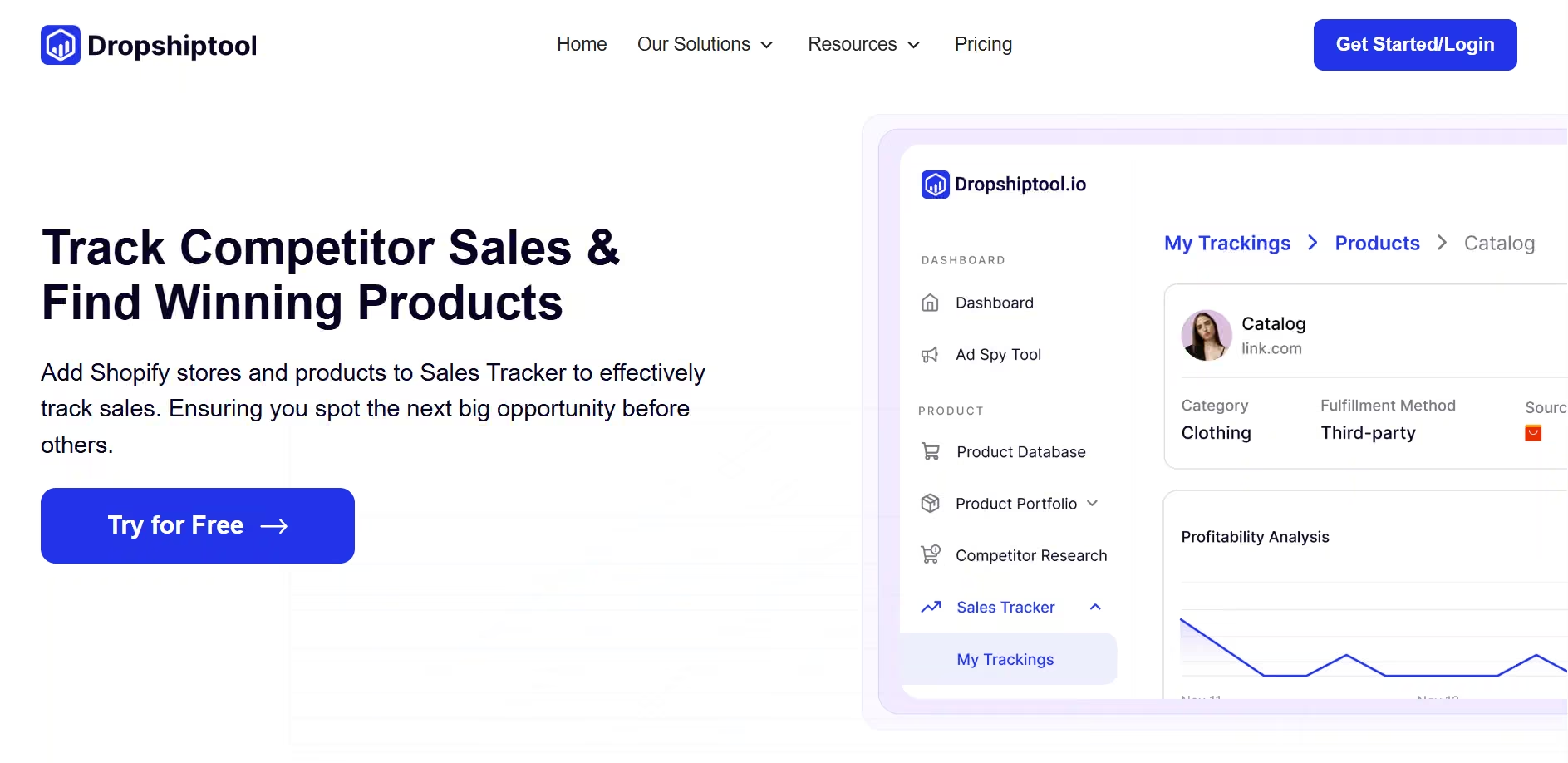
- Open the Sales Tracker to confirm real Shopify stores are selling them now, at what price, and whether sales are climbing or fading.
- Check the ads behind those stores with the Ad Spy tool to see which angles work.
- Only then search Spocket, CJ, DSers or AliDrop for the same item and compare landed cost against the price competitors charge.
Here's what that looks like with real numbers. A competitor sells a pet hair remover at $24.99. Your supplier's landed cost is $7.40. That leaves $17.59 before payment fees and ads, which is workable. If the same product costs $14 landed from a US supplier, you're left with about $11, and you'd need a cheaper ad cost per sale to make it work. Now you know which supplier to use for that product before you've spent a dollar on ads. Try Dropshiptool free to run this check on your own shortlist.
Common mistakes with Shopify supplier apps
- Paying for three apps before your first sale. Start with one free plan. Upgrade when you hit a limit.
- Keeping the supplier's photos and titles. Hundreds of stores use the same images. Rewrite titles and shoot your own photos from samples.
- Ignoring shipping profiles. If your Shopify shipping rates don't reflect the supplier's real costs per country, one order to Australia can wipe out a week of profit.
- Not watching cost changes. Supplier prices move. Recheck landed cost on your top sellers every couple of weeks.
- Staying with China shipping on a proven winner. Once a product sells steadily, move it to local stock. Our guide to dropshipping fulfillment services explains when that switch makes sense.
Pick your supplier last, not first
There's no single best dropshipping supplier for Shopify. CJ, DSers and AliDrop win on cost. Spocket and TopDawg win on speed to US shoppers. Printful and Printify own print on demand. The right choice depends on the product, so find the product first, then match it to the supplier that delivers it fastest at a margin you can live with.
Want a shortlist of products that are already selling? Create a free Dropshiptool account and start with the data.