How to Buy from Alibaba: Safe Alibaba Sourcing Guide (2026)

Buying from Alibaba is safe if you do four things: deal with Verified suppliers, pay only through Alibaba with Trade Assurance, order samples before you commit, and work out your landed cost (not the sticker price) before you negotiate. Skip any one of those and you're gambling. This Alibaba sourcing guide walks through the whole process the way a working importer does it in 2026, from the first search to a container (or a carton) landing at your door.
Quick context before we start. Alibaba.com is a business-to-business marketplace. You're buying from factories and trading companies, usually in bulk, usually with a minimum order quantity (MOQ). If you want to buy one unit and ship it to a customer, that's a different tool. Our AliExpress vs Alibaba comparison covers that split in detail.
Is Alibaba safe to buy from?
Yes, with conditions. Alibaba.com is the wholesale arm of Alibaba Group, one of the largest ecommerce companies in the world, and the platform itself isn't the risk. The risk is the individual seller. Anyone with a business license can list products, and the quality range runs from world-class OEM factories that make goods for household brands to two-person trading desks reselling whatever they can find.
Most buyers who get burned on Alibaba made one of three mistakes: they paid outside the platform, they skipped samples, or they never defined quality in writing. All three are avoidable. The rest of this guide is basically a system for not making them.
How to buy from Alibaba, step by step
Here's the full workflow. Each step gets its own section below.
- Validate the product before you look for a supplier.
- Search and shortlist 5 to 10 suppliers (filter for Verified and Trade Assurance).
- Send inquiries or post a Request for Quotation (RFQ).
- Calculate landed cost for each quote.
- Order samples from your best 2 or 3.
- Negotiate MOQ, price, and payment terms.
- Place the order through Trade Assurance with written specs.
- Book a pre-shipment inspection.
- Agree the shipping term (Incoterm) and get the goods home.
1. Validate demand first
The most expensive Alibaba mistake isn't a scam. It's 1,000 units of something nobody buys. Before you message a single factory, check that the product is already selling for someone else. Look for stores that have been running ads on it for weeks, not days, and check whether their sales are climbing or fading. The Dropshiptool Product Database is built for exactly this, and our guide to validating a product before you sell it lays out the checklist.
A common pattern among smart sellers: test a product with dropshipping first, then move the winner to Alibaba bulk once it proves itself. You give up margin during the test, but you only buy inventory for products with real sales data behind them.
2. Search and shortlist suppliers
Alibaba's search now has several modes: Products, Manufacturers, Worldwide, and an AI Mode that turns a plain-English brief into a supplier shortlist. Image Search is underrated. Upload a photo of the product you validated and you'll often find the original factory within a few results.
Once you have results, apply the filters that actually matter:
- Verified supplier. More on this below. It's the strongest trust filter Alibaba offers.
- Trade Assurance. Only suppliers enrolled in it can take protected payments.
- Years on Alibaba. Three-plus years is a reasonable floor for a first order.
- Response rate and on-time delivery rate, shown on the supplier profile.
- Main products. A factory that lists 400 unrelated products is almost always a trading company.
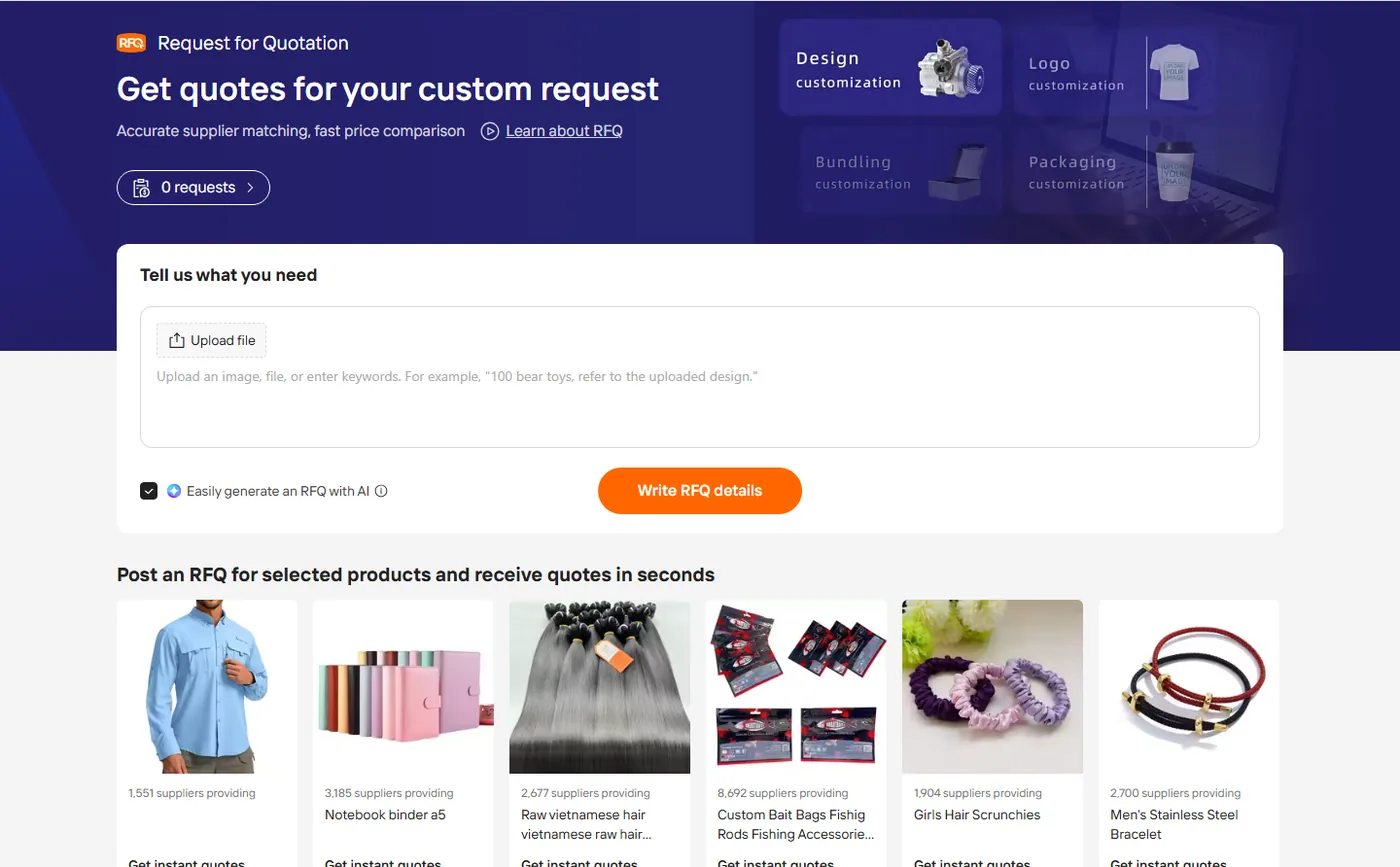
If you'd rather have suppliers come to you, post an RFQ at rfq.alibaba.com. Describe the product, quantity, target price, and any customization (logo, packaging, color). For popular categories you'll get quotes within hours. The screenshot above shows thousands of suppliers bidding on items as basic as hair scrunchies, which tells you how much negotiating room exists on commodity products.
3. Write an inquiry that gets a real answer
Factories get hundreds of “hi, what's your best price?” messages a day and answer them with a canned price list. Write like a buyer who knows what they want:
- Product spec (materials, size, weight, color codes)
- Target quantity for the first order and a realistic quantity for reorders
- Whether you need custom branding or packaging
- Destination country and preferred shipping term
- Three questions: their MOQ, sample cost, and production lead time
Ask too whether they're the factory or a trading company. Trading companies aren't bad (they often speak better English and consolidate small orders), but you'll pay a markup and they control the relationship with the real factory.
Verified supplier, Gold Supplier and Trade Assurance explained
Alibaba's badges confuse new buyers because they sound similar but mean very different things.
| Badge | What it means | What it doesn't mean |
|---|---|---|
| Verified supplier | An independent inspection firm (Alibaba names SGS and TÜV) has checked the business license, production facilities, quality control and R&D capability | That every product they ship meets your spec |
| Gold Supplier | A paid annual membership with a basic business-license check | A factory audit of any kind |
| Trade Assurance | The supplier can take payments protected by Alibaba if they ship late or the goods don't match the contract | Protection for payments made outside Alibaba |
In plain terms: Gold Supplier tells you someone paid a fee. Verified tells you a third party walked through the factory. Trade Assurance protects your money. For a first order, insist on Verified plus Trade Assurance and treat Gold Supplier on its own as nearly meaningless.
How Trade Assurance protects you
Trade Assurance is free for buyers. It covers two things: goods that aren't shipped by the date in your contract, and goods that don't meet the quality terms in your contract. If either happens, you open a dispute through your order page, the supplier gets a window to respond, and if you can't agree, Alibaba steps in and reviews the evidence. Alibaba's own guidance also describes compensation for late delivery on eligible orders, and refund windows that run from 30 to 60 days after delivery depending on your buyer tier. Check the exact window on your order, because Alibaba updates these terms.
The catch is in the phrase “as per the contract.” If your order just says “Bluetooth speaker, black, 500 pcs,” you have nothing to argue with when the speakers arrive with tinny sound and a loose charging port. Put measurable specs in the order: dimensions with tolerances, material grade, battery capacity, packaging, carton markings, and attach photos of the approved sample. Vague contract, weak protection.
And the big rule: a payment made by wire transfer to a supplier's own bank account, outside Alibaba's checkout, isn't covered. If a supplier pushes you to pay off-platform “to save fees,” walk away.
MOQs and how to negotiate them
The MOQ on a listing is an opening position, not a law. Factories set MOQs based on production runs, material minimums and how much they want your business. A few levers that work:
- Ask for a trial order. “We'd like to test 300 units before committing to 2,000 a quarter” lands much better than “can you lower your MOQ?”
- Be realistic. Moving a 1,000-unit MOQ to 500 is a normal ask. Moving it to 50 isn't going to happen for custom goods.
- Pay a bit more per unit. A 5 to 10% premium on a small first run often gets you there.
- Use their stock options. Standard colors or unbranded packaging can drop the MOQ to a few dozen units.
- Combine SKUs. Some factories accept a total MOQ across colors or sizes.
- Time it. Factories are hungriest after Chinese New Year and slowest in the run-up to Q4.
Payment terms are negotiable too. The standard is 30% deposit, 70% before shipment. Once you have a track record, push for a balance payment after inspection or partly after delivery.
Ordering samples (do not skip this)
Samples are the cheapest insurance you'll ever buy. Order from at least two or three shortlisted suppliers so you can compare quality side by side, and so you have something to negotiate with. Expect to pay for the sample plus express shipping, often $30 to $100 all in for small consumer goods. Many suppliers will credit the sample cost against your first order if you ask.
When the sample arrives, test it the way your customer will. Wash the fabric, drop the phone case, charge the gadget for a week. Then keep the approved sample and photograph it from every angle. That “golden sample” becomes the quality standard in your Trade Assurance contract and the reference for your inspector.
Alibaba payment methods compared
Paying through Alibaba's checkout is what keeps you inside Trade Assurance. Within that, you have options:
- Credit or debit card. Fast, protected, and you keep a card chargeback as a backup. Alibaba charges a processing fee of roughly 3% on card payments, which is worth it on small orders.
- PayPal, Apple Pay, Google Pay. Available in many regions, similar fees, convenient for samples.
- Bank transfer (T/T) through Alibaba. Cheapest for larger orders. It's protected only when you transfer to the account Alibaba gives you at checkout, never the supplier's personal or company account.
- Pay Later and financing. Offered to some business buyers in some countries. Read the terms carefully.
- Letter of credit. Common for very large orders, overkill for most ecommerce sellers.
Avoid Western Union, crypto, or anything sent to a supplier's personal account. None of them can be reversed.
Shipping terms: EXW, FOB and DDP in plain English
Incoterms are standard trade rules published by the International Chamber of Commerce. The current version, Incoterms 2020, has 11 rules that define who pays for each leg of the trip and when risk passes from seller to buyer. You'll see three of them constantly on Alibaba:
| Term | Supplier handles | You handle | Best for |
|---|---|---|---|
| EXW (Ex Works) | Has the goods ready at the factory | Pickup, export clearance, freight, insurance, import duties | Buyers with their own freight forwarder in China |
| FOB (Free On Board) | Delivery to the port and loading onto the ship, export clearance | Ocean freight, insurance, import clearance and duties | Most sea shipments once you have a forwarder |
| DDP (Delivered Duty Paid) | Everything, including import duties, to your door | Unloading | First orders and small shipments |
FOB is technically a sea-freight term, though suppliers often quote “FOB price” loosely for any shipment. DDP looks easiest, and for a first small order it often is. The trade-off: you can't see what you're paying for freight and duties, and some suppliers bake a fat margin into DDP quotes. Get both an FOB and a DDP quote, then ask a freight forwarder to price the FOB route. The gap tells you whether the DDP quote is fair.
Duties changed in 2025. Budget for them.
If you import into the United States, the old $800 de minimis exemption no longer protects small shipments. US Customs and Border Protection suspended duty-free de minimis treatment for goods from all countries effective August 29, 2025 (CBP guidance). Every Alibaba shipment now pays the applicable duties, whatever its value. Rates depend on the product's HTS code and country of origin and have moved a lot, so get a current figure from a licensed customs broker before you place the order, not after.
Calculate your landed cost before you negotiate
The unit price on Alibaba is only part of what each unit costs you. Here's a worked example for 500 silicone pet bowls quoted at $2.10 FOB Ningbo. The duty rate and freight numbers are illustrative; plug in your own.
| Cost line | Amount |
|---|---|
| Goods (500 x $2.10) | $1,050 |
| Sea freight, shared container (LCL) to Los Angeles | $380 |
| Import duties (example rate of 30% on goods value) | $315 |
| Customs broker and port fees | $150 |
| Pre-shipment inspection | $118 |
| Trucking from port to your warehouse or 3PL | $120 |
| Total landed cost | $2,133 ($4.27 per unit) |
That $2.10 bowl actually costs $4.27 before you've paid for ads, fulfillment or returns. If you planned to sell at $12.99, your margin just got a lot thinner. Run the full numbers through our profit margin calculator before you sign anything.
Book a pre-shipment inspection
Once production finishes and before you pay the balance, have someone open the cartons. You can hire an independent inspection company, or book one through Alibaba's own Production Monitoring and Inspection Services.
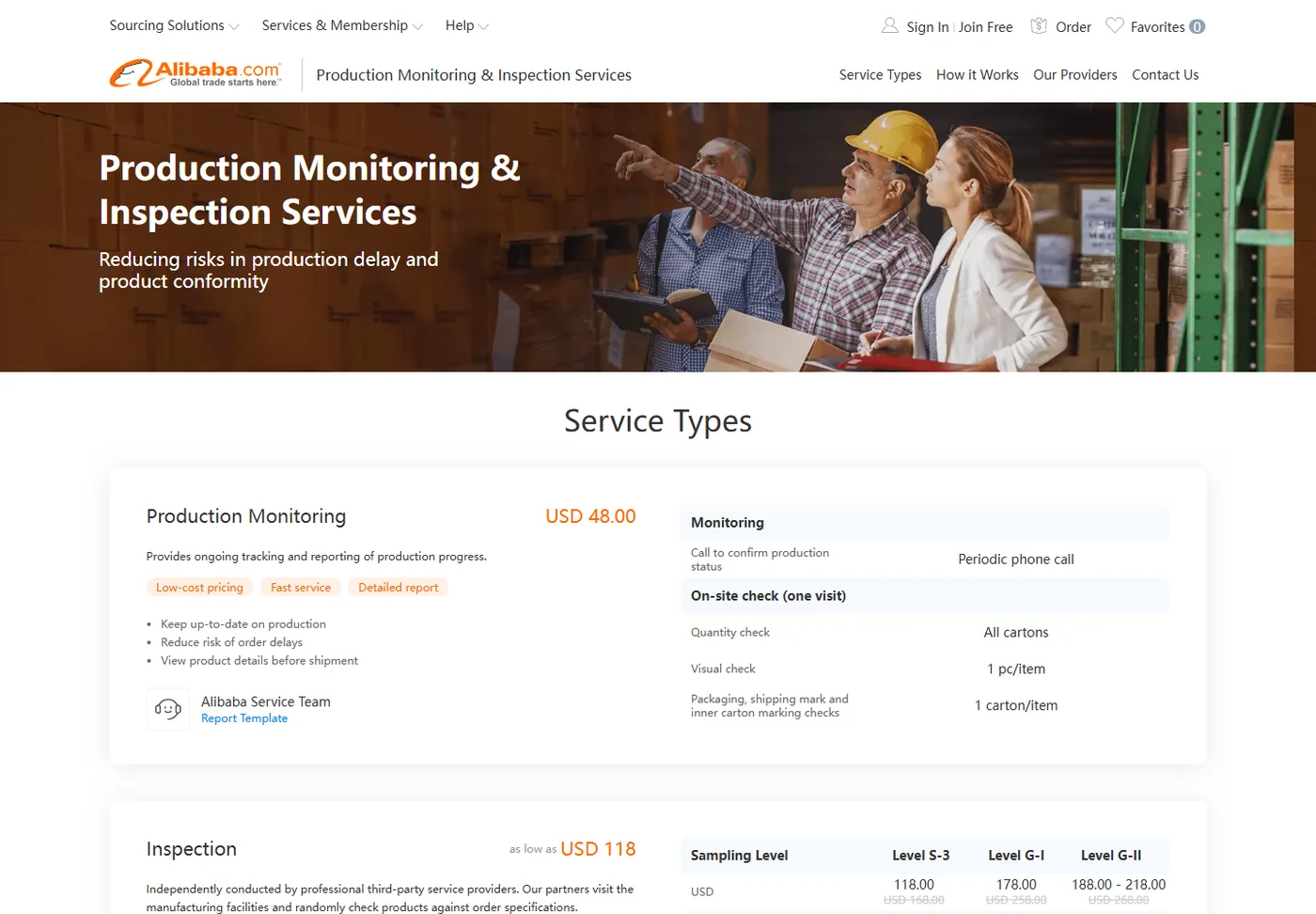
When we checked in October 2026, Alibaba listed production monitoring at USD 48 and third-party inspections starting at USD 118, with higher sampling levels costing more. On a $1,000+ order that's cheap protection. The inspector checks quantity, workmanship, packaging and carton markings against your golden sample and sends a photo report. If the report shows problems, you still have leverage, because you haven't paid the 70% balance yet.
How to avoid Alibaba scams
Real scams on Alibaba follow a handful of patterns. Learn them and you'll spot most of them in the first few messages.
- The “bank details changed” email. Mid-order, you get an email (often from a lookalike address) saying the supplier's bank account has changed. It's almost always fraud. Never change payment details based on an email; confirm inside Alibaba's message center.
- Off-platform payment pressure. “Pay us directly and we'll give you 5% off.” That 5% costs you all of your protection.
- Prices far below everyone else. If ten suppliers quote $4 and one quotes $1.50, the cheap one is cutting material, quantity, or corners you can't see in a photo.
- The bait sample. A perfect sample followed by a production run made from cheaper materials. Inspections and a detailed contract stop this.
- Branded goods. “Factory-direct” Nike, Apple or Stanley products are counterfeits. Importing them can get your shipment seized and your store shut down.
- Trading companies posing as factories. Not a scam on its own, but it matters for pricing. Ask for a video call walking the production floor.
Our broader guide to spotting dropshipping and supplier scams covers more red flags across other platforms.
Alibaba for dropshipping: the Alibaba Dropshipping Center
Alibaba isn't only bulk anymore. Its Dropshipping Center lists products with no minimum order, and you can connect a store on Shopify, WooCommerce, Wix, Amazon or TikTok Shop, push products to it from a sourcing list, and have orders forwarded to suppliers. Filters let you pick products shipping from the United States or Europe, products marked TikTok Shop US Ready, items held in verified warehouses, and even a target profit margin.
How it compares in practice: the Dropshipping Center has better access to factory pricing than most AliExpress listings, and orders placed through it fall under Trade Assurance. On the other hand, the catalog is smaller than AliExpress's, supplier fulfillment speed varies a lot, and product pages are often written for wholesale buyers, so you'll rewrite every description. If you plan to dropship from China, also look at the AliExpress Dropshipping Center and AliDrop, an AliExpress dropshipping app that also pulls in Alibaba and Temu selections. For faster US and EU delivery, Spocket's suppliers ship from inside those regions.
Alibaba vs AliExpress: which one do you need?
Short version: Alibaba is for buying inventory in bulk and building your own brand, while AliExpress is for buying single units at fixed prices with no MOQ. Most stores use both at different stages, testing products with AliExpress or a dropshipping supplier and then moving proven winners to Alibaba for better margins and custom packaging. The full side-by-side, including a comparison table, is in our AliExpress vs Alibaba guide. If you want more options beyond these two, see our list of the best dropshipping suppliers in China.
Where Dropshiptool fits in your Alibaba sourcing
Alibaba tells you what can be made. It doesn't tell you what will sell. That gap is where most first-time importers lose money. Before you commit to an MOQ, use Dropshiptool to see which Shopify stores are already selling the product, how their revenue is trending in the Sales Tracker, and which ad creatives they're running on Facebook and TikTok. If a product's sales have been flat for three months, you'll know before you're sitting on 1,000 units. You can try Dropshiptool and check your shortlist in an afternoon.
Ready to place your first Alibaba order?
Keep the first order small, pay through Trade Assurance, put your specs in writing and inspect before you pay the balance. Do that and Alibaba is one of the best margin levers an ecommerce business has. Find a product with proven demand first: start your Dropshiptool account and validate your next product before you source it.