





If you want a dropshipping for beginners PDF you can actually work from, not a 90-page ebook padded with motivation, we've written one. The Beginner's Guide to Dropshipping (2026) is a free, 14-page guide that walks you from "what is this?" to a tested store in 30 days, with checklists, a worked margin example and a day-by-day launch plan. No email wall. Download it, print it, scribble on it.
Download the free PDF guide (14 pages, 1.5 MB)
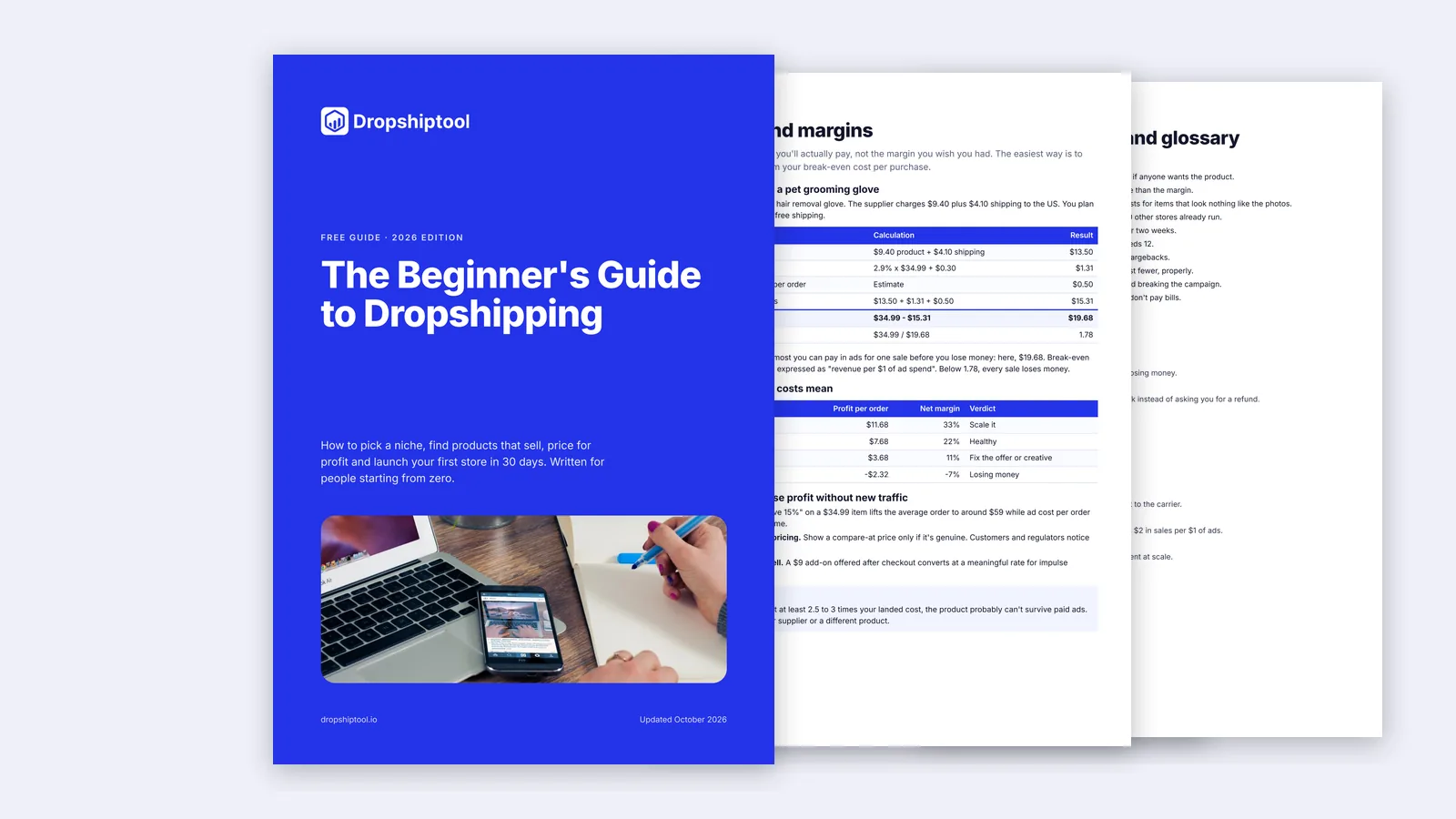
Below is a full summary of every chapter, so you can read the key ideas here and keep the PDF as your working copy. If you only have five minutes, skip to the 30-day plan.
What's inside the beginner's guide to dropshipping
The guide has 11 short chapters. Most end with a "do this today" task or a rule of thumb, because reading about dropshipping is easy and starting is the part most people put off.
| Chapter | What you'll get from it |
|---|---|
| 1. How dropshipping works | The order flow and where every dollar of a $35 sale goes |
| 2. Is it worth it in 2026? | Honest pros and cons, plus a starting budget of $300 to $1,000 |
| 3. Choosing a niche | A six-point niche scorecard and niches to avoid |
| 4. Winning products | Four research sources and a 10-point validation checklist |
| 5. Suppliers | AliExpress vs US/EU suppliers vs agents, and how to run test orders |
| 6. Pricing and margins | A worked example with break-even CPA and ROAS |
| 7. Building your store | Store setup checklist and the anatomy of a product page that sells |
| 8. First sales | Picking one traffic channel and a simple ad test structure |
| 9. Daily operations | A 30-minute routine, refunds, chargebacks and taxes |
| 10. 30-day launch plan | Day-by-day tasks from zero to a tested store |
| 11. Mistakes and glossary | Ten common beginner errors and the terms you'll hear |
Chapter 1: How dropshipping works and how the money moves
Dropshipping is retail without a stockroom. You run the store and the marketing; a supplier holds the inventory and ships each order directly to your customer. When someone buys from you, you pay the supplier the wholesale price plus shipping and keep the difference. If you want the longer explanation, our guide to what dropshipping is and how it works covers the model in more depth.
The chapter that matters most for beginners is the money breakdown. People see "sell for $35, buy for $10" and assume they make $25. Here's what a realistic $34.99 order looks like once everything is paid:
- Product cost: $9.40
- Shipping to the customer: $4.10
- Payment processing (about 2.9% + $0.30): $1.31
- Apps, per order: $0.50
- Ad cost per order: $12.00
- What you keep: $7.68, about 22% net
The ad cost line decides everything. Two stores selling the identical product can have opposite results because one finds customers for $8 and the other pays $25. That's why the rest of the guide keeps coming back to testing and break-even numbers.
Chapter 2: Is dropshipping still worth it in 2026?
Short answer: yes, if you treat it as a retail business with thin margins. No, if you expect a store to run itself after a weekend of setup. Ads cost more than they did five years ago, customers expect faster delivery, and good products get copied within days. What still works is choosing products with a clear reason to buy now, using suppliers with reliable delivery times and testing on small budgets before scaling.
The guide includes a starting budget table. The store itself is cheap. Shopify currently offers a short free trial and then a reduced first few months (check Shopify's pricing page for the current offer in your country). The real spend is ad testing, usually $250 to $800 in the first month, plus $30 to $80 for sample orders. A typical total lands between $300 and $1,000.
One warning from the guide that's worth repeating here: revenue screenshots are not profit. Before believing anyone's numbers, ask what they spent on ads, product and refunds.
Chapter 3: Choosing a niche you can actually sell in
A niche is a group of buyers with a shared problem or passion, not a product category. "Kitchen" is a category. "People who meal prep every Sunday" is a niche, and it's far easier to write ads for.
The PDF gives you a scorecard. Rate each idea 1 to 5 on:
- Passion or pain (do buyers spend without being asked twice?)
- Price room (can products sell for $25 to $80?)
- Shipping friendliness (small, light, not fragile)
- Repeat or add-on potential
- Not dominated by one big brand
- Looks good in a 15-second video
Anything under 20 out of 30 gets dropped. Beginner-friendly niches include pet accessories, home organisation, at-home fitness and car accessories. Avoid supplements and anything with health claims (ad platforms restrict them), licensed goods, large furniture and cheap battery-powered electronics. For a deeper process, see how to choose a dropshipping niche.
Chapter 4: Finding and validating winning products
A winning product is one that sells profitably through ads or content. You find them by studying what already sells, then checking you can sell it cheaper, better or to a different audience. The guide lists four sources:
- Ad libraries. The Meta Ad Library and TikTok Creative Center show live ads. An ad running for weeks with new variations is usually making money.
- Competitor stores. See which products Shopify stores in your niche push, and use a sales tracker to see what actually moves.
- Marketplaces. Amazon Best Sellers, AliExpress order counts and eBay sold listings show demand at different price points.
- Product databases that collect trending products with sales estimates.
Then run each product through the 10-point validation checklist. A few of the points: retail price at least 3x landed cost, at least one other store currently advertising it, available from two suppliers, ships in under 10 days, and you can think of three distinct ad angles. Products need to pass seven of the ten before you spend anything on ads.
This is where Dropshiptool saves you hours. The Product Database lets you filter trending products by niche, price and estimated sales, and the Sales Tracker shows what competitor stores are really selling. You can try it free while you work through this chapter.
Chapter 5: Choosing suppliers and placing test orders
Your supplier is your warehouse, packing team and delivery partner rolled into one. The guide compares the main routes:
| Route | Typical US delivery | Product cost | Best for |
|---|---|---|---|
| AliExpress (via an app like AliDrop) | 7-20 days, faster from local warehouses | Lowest | Cheap testing, huge range |
| US/EU suppliers (e.g. Spocket) | 2-7 days | Higher | Brand-style stores, fewer refunds |
| Agents and fulfilment platforms | 5-15 days | Low to mid | Scaling a proven product |
| Private agent or factory | Depends on setup | Lowest at volume | 30+ orders a day |
A common path is to test with AliExpress or Spocket, then move a proven winner to an agent once you have the volume to negotiate. The supplier checklist covers rating (95%+ positive), store age, recent photo reviews, stated processing time, message response time and whether they'll leave invoices out of the parcel.
Never skip test orders. Order your top two or three products to your own address, time the delivery, check the packaging and quality, and film your own content while you're at it. Original footage beats the supplier's photos that 50 other stores already use. Our guide on how to find dropshipping suppliers goes further on vetting.
Chapter 6: Pricing and margins, with a worked example
This is the chapter most free dropshipping guides skip. Price for the ad cost you'll actually pay, then work backwards from your break-even cost per purchase.
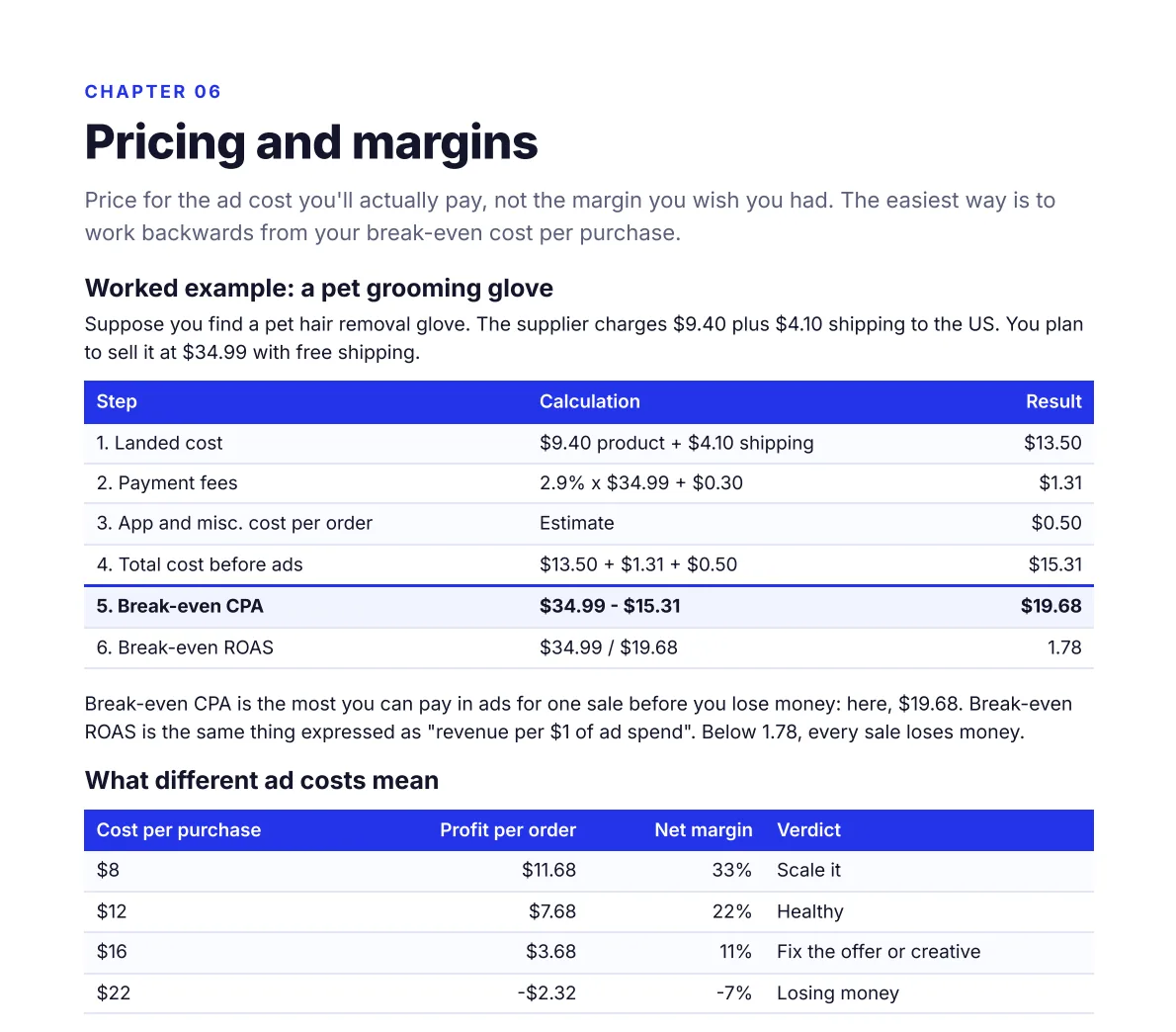
The example uses a pet hair removal glove: $9.40 from the supplier, $4.10 shipping, sold at $34.99 with free shipping.
- Landed cost: $9.40 + $4.10 = $13.50
- Payment fees: 2.9% of $34.99 + $0.30 = $1.31
- Apps and misc: $0.50
- Total cost before ads: $15.31
- Break-even CPA: $34.99 - $15.31 = $19.68
- Break-even ROAS: $34.99 / $19.68 = 1.78
So you can pay up to $19.68 in ads for each sale before losing money. At a $12 cost per purchase you keep $7.68 (22%). At $22 you lose $2.32 on every order. The rule of thumb: if retail isn't at least 2.5 to 3 times landed cost, the product probably can't survive paid ads. Plug your own numbers into our dropshipping profit margin calculator.
The guide also covers three ways to raise profit without new traffic: bundles ("buy 2, save 15%" lifts a $34.99 order to about $59), honest compare-at pricing, and post-purchase upsells.
Chapter 7: Building your store
Your store has one job: convince a stranger from an ad that it's safe to hand over card details. Shopify is the default because nearly every supplier app, review app and ad integration supports it. WooCommerce is cheaper if you're comfortable with WordPress.
The PDF includes a two-column checklist. Must-have pages: home page, product page with real photos and video, shipping policy with honest delivery times, refund policy, contact page, about page, privacy policy and terms, and an order tracking page. Settings people forget: custom domain, a real test payment, shipping rates that match supplier costs, tax settings, Meta and TikTok pixels, abandoned checkout emails and mobile load speed.
For the product page, lead with the outcome ("remove pet hair in one stroke" beats "Pet Grooming Glove 2.0"), put a video in the first two images, add three to five benefit bullets, show a delivery estimate near the buy button and include an FAQ block. Use only genuine reviews. The FTC's guidance on reviews and endorsements is clear that fake reviews can land you in real trouble.
Chapter 8: Getting your first sales
Traffic is the business. The guide's advice is to pick one channel, learn it properly, and only add a second once the first is profitable. TikTok organic costs nothing but time and is unpredictable. TikTok and Meta ads usually need $20 to $50 a day to learn anything. Google Shopping suits products people already search for.
The ad test structure is simple:
- Make 3 to 5 short videos, each with a different hook in the first two seconds.
- Launch with roughly 1x your break-even CPA per ad set per day.
- Leave it alone for 3 days.
- Kill ads that spend 1.5x break-even CPA without a purchase.
- Make variations of the winning hook.
- Increase budgets 20-30% every couple of days rather than doubling overnight.
It also explains which metric points to which problem: low hook rate means fix the opening, low CTR means the ad isn't creating curiosity, low add-to-cart with good CTR points at the product page or price.
Chapter 9: Running the business day to day
After launch, the work shifts from building to operating. The guide's 30-minute daily routine: confirm new orders were sent and paid, chase tracking on anything older than five days with no movement, answer every email within 24 hours, review yesterday's ad spend against break-even, and log every refund with its reason.
Most chargebacks start as an unanswered "where is my order?" email. Reply with the tracking link and a realistic date, and refund or reship lost parcels before the customer goes to their bank. Keep your refund rate under about 5%; above that, stop scaling and find the cause.
On paperwork, register a business once sales are regular, understand sales tax nexus in the US (or VAT in the UK and EU), and keep every receipt. The IRS small business and self-employed hub is a good starting point for US sellers, and our post on dropshipping taxes covers the basics.
Chapter 10: The 30-day dropshipping launch plan
This is the page most readers print and stick on the wall. It turns everything above into dated tasks.
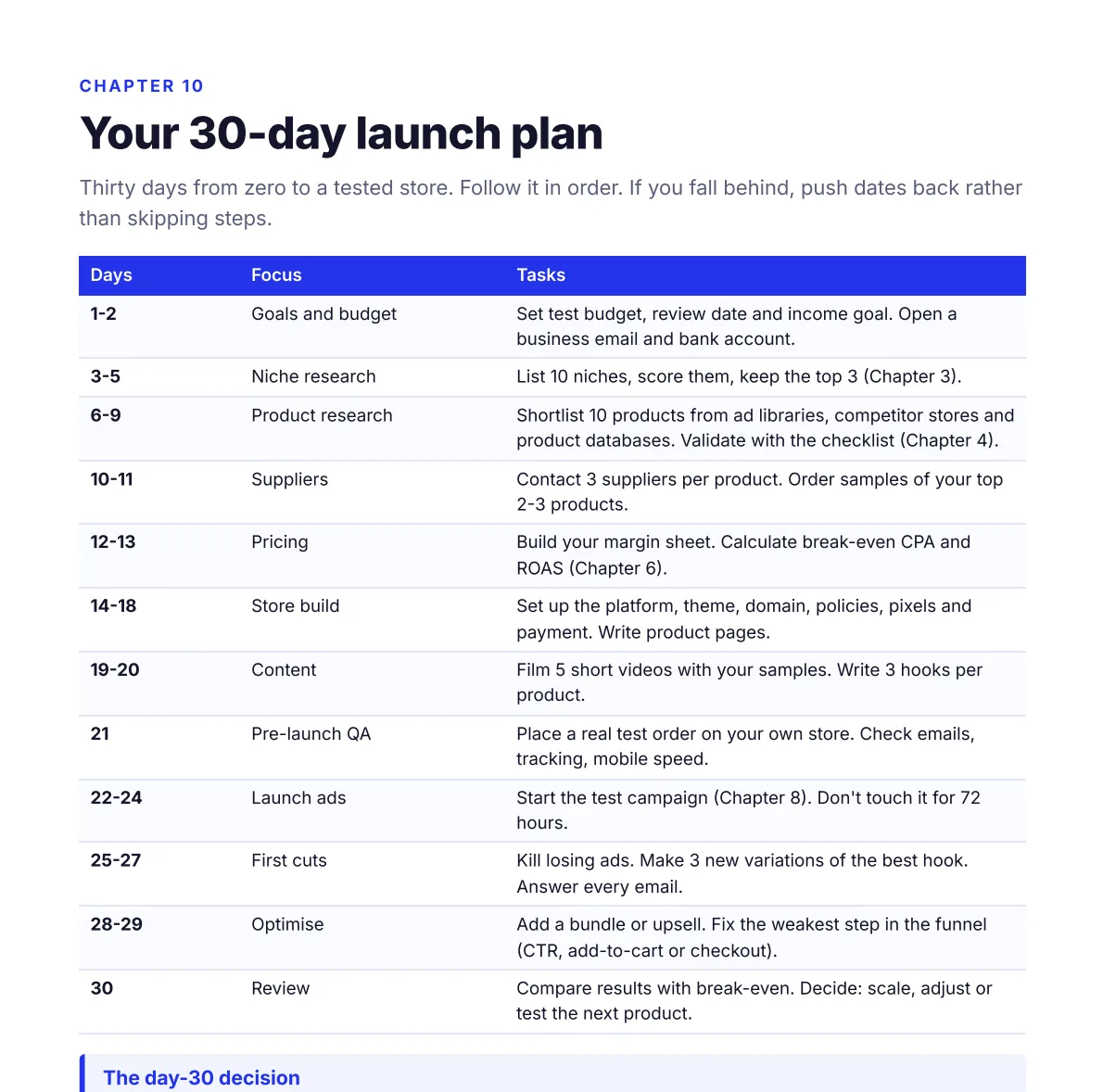
| Days | Focus | Main tasks |
|---|---|---|
| 1-2 | Goals and budget | Set test budget and review date, open business email and bank account |
| 3-5 | Niche | Score 10 niches, keep the top 3 |
| 6-9 | Products | Shortlist 10 products, validate with the checklist |
| 10-13 | Suppliers and pricing | Contact suppliers, order samples, build your margin sheet |
| 14-21 | Store and content | Build the store, film 5 videos, place a real test order |
| 22-27 | Launch | Run the ad test, wait 72 hours, cut losers, iterate on winners |
| 28-30 | Optimise and decide | Add a bundle or upsell, compare results with break-even, decide next step |
The day-30 decision is spelled out: if CPA is below break-even, scale gradually. If it's within 20% of break-even, fix the offer before giving up. If you've spent 1.5 to 2 times break-even per product with no sales, move to product two. Most winners aren't the first product tested.
Chapter 11: Beginner mistakes to avoid
The final chapter lists the ten mistakes we see most often. The top five:
- Spending two weeks building a store before checking anyone wants the product.
- Pricing at 2x cost, then discovering ads cost more than the margin.
- Skipping test orders and getting refund requests for items that look nothing like the photos.
- Running the same supplier videos that dozens of other stores already use.
- Killing ads after one day, or letting losers run for two weeks.
It closes with a glossary of the terms you'll hear in every dropshipping forum: AOV, break-even CPA, chargeback, CTR, landed cost, processing time and ROAS.
Why we made this dropshipping guide PDF
Most free "dropshipping for beginners PDF" downloads are lead magnets for a course or app, and they read like it. They tell you dropshipping is easy, show a revenue screenshot and stop right before the hard parts. We wanted a guide that covers the unglamorous bits: margins after ad costs, what a realistic budget looks like, when to give up on a product, and how to avoid chargebacks.
It's also short on purpose. Fourteen pages means you'll finish it, and the checklists turn each chapter into something you can act on. If you want to go further after reading, our longer guide on how to start a dropshipping business expands each step.
Get your first product idea faster
The guide gives you the process. Dropshiptool gives you the data to run it: a Sales Tracker for any Shopify store, a Product Database, a weekly Product Portfolio of winning products, Ad Spy for Facebook and TikTok, and Competitor Research. Pair it with Spocket for fast US/EU suppliers or AliDrop for AliExpress products and you've got the whole stack from this guide.
Download the free PDF guide, then create your free Dropshiptool account and start Chapter 4 with real sales data.


