Spocket Was Only the Beginning: How Saba Mohebpour’s $50M ILA Capital Is Reshaping Ecommerce Apps

The e-commerce software landscape is entering a new era.
For years, merchants have focused on products, stores, ads, and sales. But behind every successful online business is a quiet stack of tools doing the heavy lifting. Shopify merchants often rely on dozens of independent apps for sourcing, reviews, upsells, email, analytics, shipping, customer support, and automation.
Now, the app layer is becoming one of the most valuable parts of e-commerce.
Saba Mohebpour, the founder of Spocket, seems to have spotted this shift early. After building one of the most recognisable names in Shopify dropshipping, he is now taking a bigger swing through ILA Capital, a $50 million acquisition strategy focused on buying and scaling Shopify and ecommerce SaaS apps.

This is not just another investment move. It is a clear signal that the next major opportunity in e-commerce may not be the stores themselves, but the software powering them.
Spocket Was Saba’s First Big Ecommerce Win
Before ILA Capital, Saba built Spocket into a major platform in the dropshipping space.
Spocket became known for helping merchants find quality products from suppliers in regions such as the US and Europe, giving dropshippers an alternative to slow shipping and generic product sourcing. For Shopify sellers, that mattered. It helped solve one of the biggest pain points in dropshipping: finding reliable suppliers and creating a smoother customer experience.
That is why Spocket became more than just another app. It became a recognisable e-commerce brand.
Saba’s success with Spocket gave him something most investors do not have: deep, hands-on experience with merchant problems. He understands what sellers need, what tools they keep paying for, and what makes an e-commerce app truly valuable.
That founder-level insight is now shaping ILA Capital’s acquisition strategy.
Meet ILA Capital
ILA Capital is Saba Mohebpour’s next major move.
Backed by a $50 million acquisition strategy, the fund is focused on buying profitable software and internet businesses, especially e-commerce apps that already have users, revenue, and proven demand.
The philosophy is simple but powerful: buy products that already work, improve operations, and scale distribution.
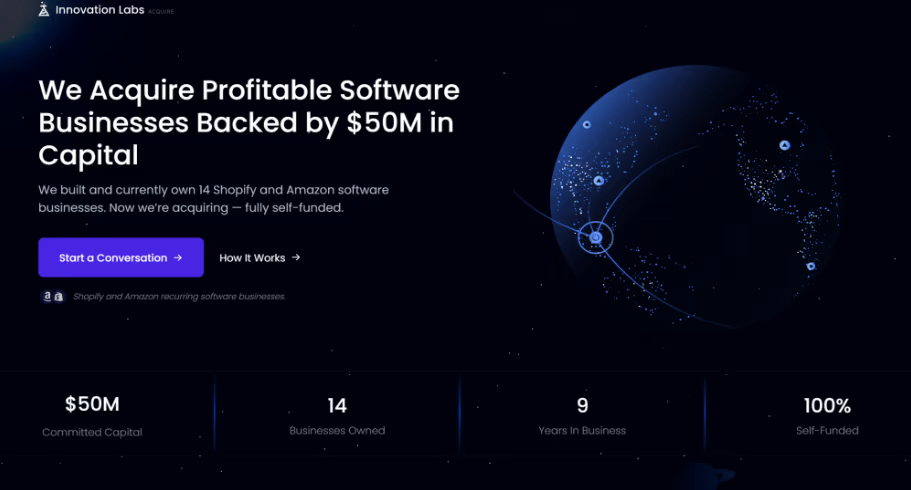
That makes ILA Capital different from traditional venture capital. VC often bets on early-stage companies that may or may not succeed. ILA Capital appears to be focused on proven products with real customers and existing revenue.
This is where Saba’s operator mindset becomes important.
He is not just looking at spreadsheets. He can evaluate whether an app solves a real merchant pain point, whether users are likely to stay, and whether the product can grow with better onboarding, support, marketing, pricing, integrations, or AI features.
That makes ILA Capital more than a buyer. It positions the company as a potential growth engine for e-commerce software.
Why Ecommerce Apps Are Suddenly Hot Assets
Shopify’s growth created an entire economy around e-commerce software.
Thousands of niche apps now solve specific problems for merchants. Some help increase average order value. Some manage reviews. Some automate product imports. Some improve email marketing, fulfilment, returns, customer support, and analytics.
These apps may look small from the outside, but many are incredibly valuable. They generate recurring subscription revenue, operate with lower overhead than product-based ecommerce businesses, and become deeply embedded in merchant workflows.
Once a store depends on an app, replacing it becomes difficult.
That stickiness is exactly why e-commerce SaaS is attracting more attention. Merchants do not just install apps for convenience. They rely on them to run and grow their businesses.
AI is making this even bigger. E-commerce apps can now add AI-powered product research, description writing, support replies, image editing, pricing insights, and automation. This turns ordinary tools into smarter business systems.
Saba’s timing is sharp. He is entering the acquisition market just as e-commerce software is becoming more essential.
Could Your Favourite Shopify App Be Acquired Next?
It is very possible.
The Shopify app ecosystem is full of focused tools built by small teams and indie founders. Many of these apps already have strong users but limited resources to scale. That makes them natural acquisition targets.
Categories most likely to see consolidation include review apps, upsell and cross-sell tools, sourcing apps, AI content tools, analytics dashboards, shipping apps, returns software, email and SMS tools, and customer support platforms.
For merchants, acquisitions can bring both opportunity and concern.
On one hand, a well-run acquisition can mean better support, stronger features, improved reliability, and smarter integrations. On the other hand, merchants may worry about pricing changes, product direction, or too much control being concentrated under a few e-commerce holding companies.
Still, consolidation feels almost inevitable. As e-commerce becomes more complex, merchants want tools that work better together. Buyers like ILA Capital can create value by connecting apps, improving operations, and giving small products more room to grow.
Rise of E-commerce Holding Companies
ILA Capital fits into a larger trend: the rise of e-commerce holding companies.
In consumer ecommerce, companies like Thrasio made the roll-up model famous by acquiring Amazon brands. In SaaS, aggregators have used similar models to buy and grow profitable software companies.
Now, that logic is moving deeper into the e-commerce infrastructure.
Instead of building one brand, companies are starting to own the tools behind many brands. This is a major shift. The most valuable position may no longer be selling one product to consumers. It may be owning the software that thousands of merchants use to sell millions of products.
That is why Saba’s strategy feels ambitious.
He is not just buying apps. He is positioning ILA Capital inside the operating layer of e-commerce.
What Founders and Merchants Should Watch
Founders building e-commerce apps should pay attention.
The market is rewarding products with clean revenue, low churn, strong reviews, clear documentation, and real merchant value. Apps that save time, increase sales, reduce manual work, or add AI-powered efficiency could become especially attractive.
Merchants should also watch how acquisitions affect their tech stack. More M&A could lead to better-integrated tools, but it could also change pricing, support, and product roadmaps.
Either way, e-commerce software is becoming more valuable, more competitive, and more institutionalised.
Conclusion
Spocket may have only been Saba Mohebpour’s first major act.
With ILA Capital and a $50 million acquisition strategy, he is stepping into a much larger opportunity: the infrastructure layer behind modern ecommerce. His move shows a clear understanding of where the market is heading and where long-term value is being created.
The next battle in e-commerce is not just for products.
I is for the software layer underneath them.