ShopHunter vs Dropshiptool.io: Best Shopify Spy Tool

Running a dropshipping store without solid market intel is like flying blind. You need real data on what's selling, which ads work, and how competitors operate.
Two platforms claim to give you that edge: ShopHunter and Dropshiptool.io.
Both let you spy on Shopify stores, track product performance, and uncover winning items before your rivals do. But they work differently, charge different prices, and offer different tools. Choosing between them matters because the right platform can cut your research time in half and help you spot trends faster.
This guide breaks down what each tool actually does, how they compare feature-by-feature, and which one fits your business. By the end, you'll know exactly which platform to pick—or if using both makes sense for your strategy.
What is ShopHunter?
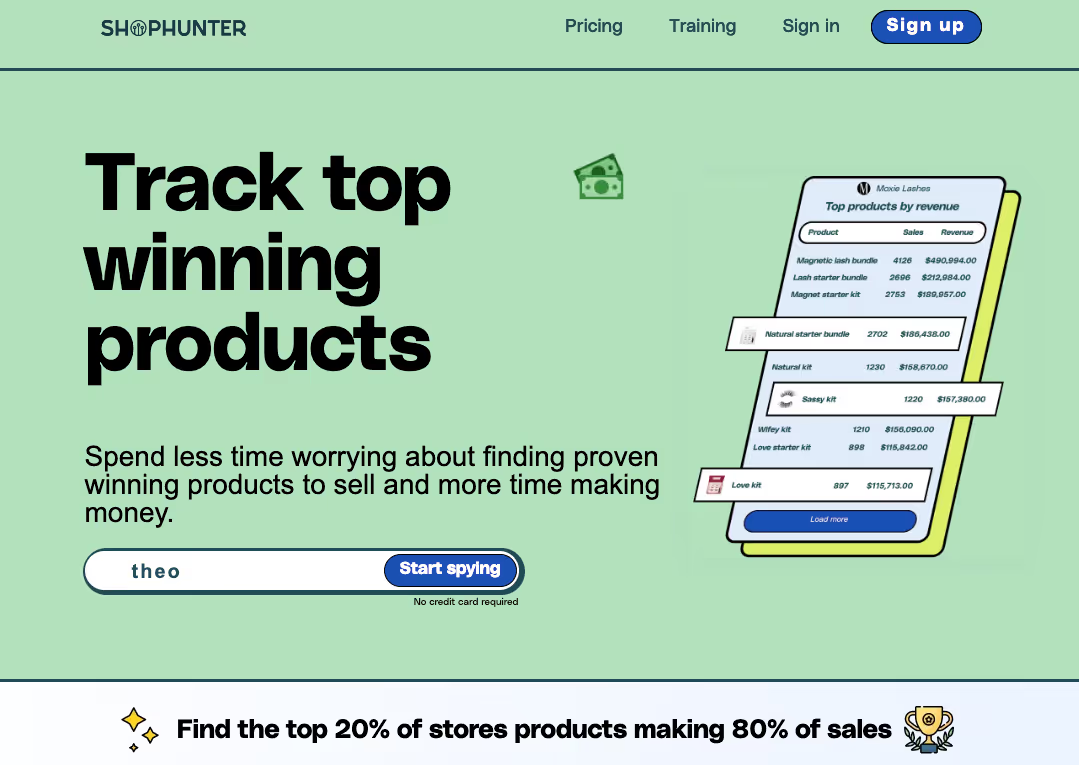
ShopHunter is a Shopify spy tool built for competitor analysis and product research. When you add a Shopify store URL to ShopHunter, the tool estimates that store's daily revenue, order volume, and average product pricing. You get access to real-time data on which products are selling best, how fast sales are moving, and which items competitors are pushing.
ShopHunter’s highlight is its tracking system. You can monitor up to 25 stores on the Basic plan or 50 stores on the Professional plan. The tool updates hourly, so you see changes in pricing, product listings, and sales velocity almost as they happen. It also includes ad intelligence—you can spy on Facebook ads competitors are running and see engagement data. ShopHunter uses a probabilistic algorithm that analyzes public data signals to estimate sales figures and product performance.
ShopHunter keeps things simple. There's no product database to browse or complex features to learn. You add stores, track them, and watch the data roll in. It's ideal if you want a lean tool focused on competitor monitoring without extra features getting in the way.
What is Dropshiptool.io?
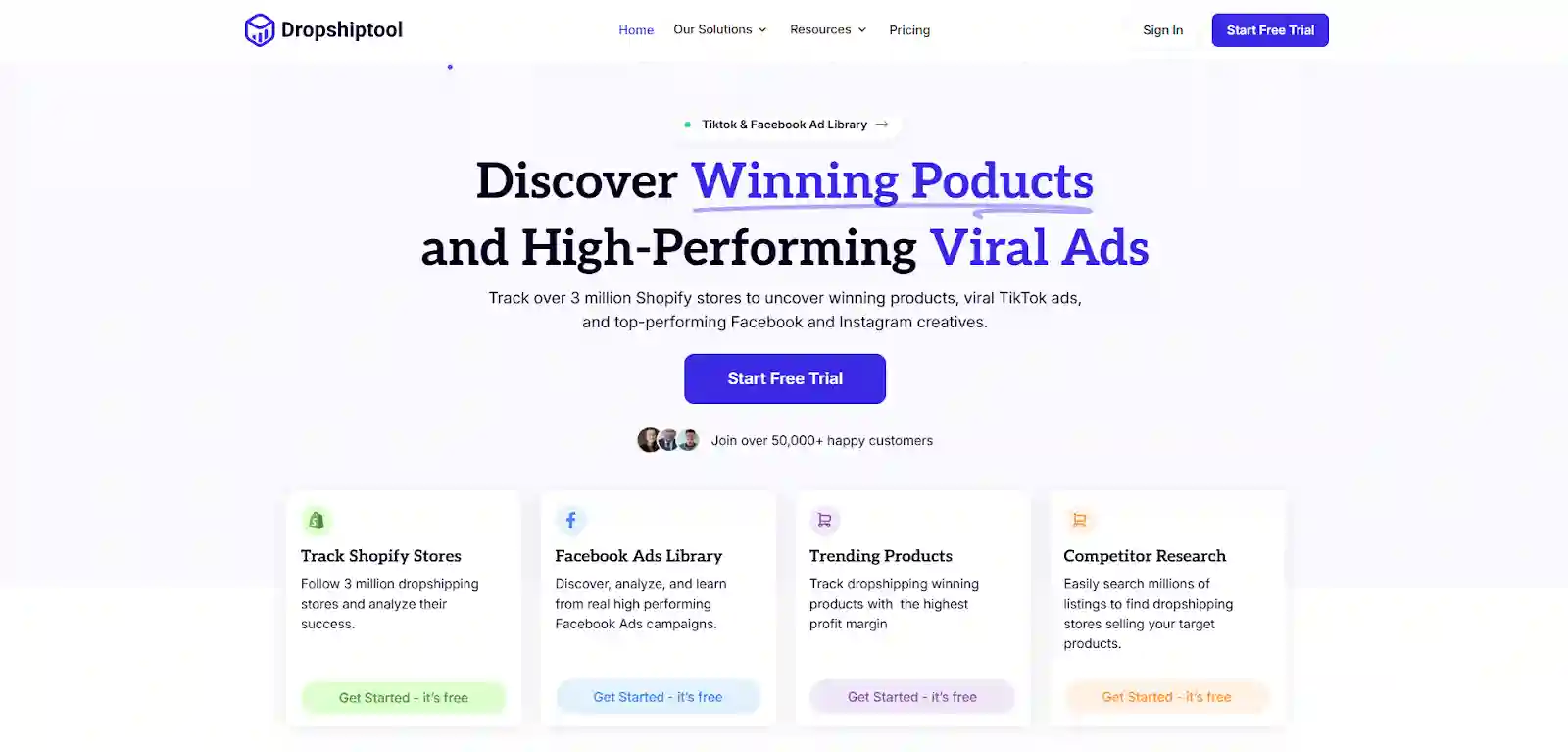
Dropshiptool.io is an all-in-one research platform that goes beyond simple competitor tracking. Instead of just watching what competitors are doing, Dropshiptool.io gives you a full toolkit: a product database with millions of items, an ad spy tool for Facebook and TikTok, a sales tracker, competitor research, and curated weekly product picks.
The product database is where Dropshiptool.io stands out. You get access to millions of products filtered by price, profit margin, demand, and sales volume. Unlike ShopHunter, you're not just spying on existing stores—you're actively searching for products before anyone else lists them. The ad spy tool shows you top-performing Facebook and TikTok ads, so you can see which creatives and angles are driving sales right now.
Dropshiptool.io also delivers a product portfolio each week—40 to 50 pre-vetted products selected by AI and expert review. These weekly drops save time if you want fresh product ideas without endless scrolling. The sales tracker lets you monitor real revenue from any Shopify store, and the competitor research feature maps out what your rivals are doing across their entire catalog.
ShopHunter’s Features
We will compare Dropshiptool vs ShopHunter in several areas. Let’s get to it now:
Competitor Store Tracking
ShopHunter's main value is tracking competitor stores. You add a URL, and the tool shows you estimated daily revenue, total orders, and average order value. You can see which products are trending in each store and how sales velocity is changing. This data refreshes hourly, so you catch shifts in real-time.
Top Stores and Products Lists
The tool includes global lists of top-performing stores and products. On the Basic plan, you see the top 20 products globally. The Professional plan bumps that to more visibility. These lists help you spot industry trends and find new stores worth tracking.
Facebook Ad Intelligence
ShopHunter shows you ads competitors are running on Facebook. You can see engagement metrics, creative elements, and which products are being pushed hard. This helps you understand not just what's selling, but how competitors are marketing it.
Tagging System
ShopHunter lets you organize tracked stores and products with custom tags. You can sort by niche, price range, performance level, or whatever criteria matter to you. This keeps things organized if you're tracking dozens of competitors.
Historical Sales Data
The tool stores sales history, so you can spot seasonality and consistency. If a product had a sales spike two months ago and it's trending again, you'll see the pattern. This helps you predict which items might be worth testing.
Dropshiptool’s Features
Now let’s take a look at what Dropshiptool has to offer:
Product Database
Dropshiptool gives you access to millions of dropshipping products with real performance metrics. You can filter by price range, profit margin, monthly revenue, and trend velocity. The search function lets you narrow down by category or niche. Unlike ShopHunter, you're not just watching competitors—you're actively hunting for products with proven demand signals.
Ad Spy Tool
Dropshiptool.io's ad spy covers both Facebook and TikTok. You see top-performing ads, engagement data, and creative angles that are driving conversions. This is crucial because TikTok ads often reveal trends before they hit mainstream channels. You get to see which angles work before running your own tests.
Sales Tracker
The sales tracker shows live and historical revenue from any Shopify store. Unlike ShopHunter's algorithm-based estimates, Dropshiptool.io tracks actual sales data from monitored stores. You see order velocity, revenue cadence, and product ranking stability. This gives you confidence in which products are genuinely hot.
Product Portfolio
Every Monday, Dropshiptool.io drops 40 to 50 curated products into your dashboard. These items go through AI analysis and expert review, so you're not getting random picks. You can import these directly into your store with one click. This feature alone saves hours if you're constantly searching for fresh products.
Competitor Research
This feature centralizes competitor data with product-level insights and change tracking. You can see what competitors are adding, how they're pricing, and how often they update. Instead of guessing who your competition is, you see them all organized in one place.
Store and Product Tracking
You can track over 3 million Shopify stores and get alerts on product changes. The one-click import means you can add any product to your store instantly. Weekly trend emails keep you in the loop on what's hot.
Dropshiptool vs ShopHunter: Pricing
Here is how you can compare ShopHunter vs Dropshiptool’s pricing plans:
ShopHunter Pricing
ShopHunter has two main plans:
- Basic: $50/month – Tracks 25 stores, shows top 40 global stores and top 20 products, includes email support.
- Professional: $75/month – Tracks 50 stores, includes ad data, more features, better support.
There's a 3-day trial for $1, no credit card required. No annual discount is mentioned, so month-to-month is standard.
Dropshiptool.io Pricing
Dropshiptool.io has four plans:
- Starter: 25 searches/day (product database), 10 searches/day (competitor research), 1,000 ad credits, 10 products/week, 10 stores tracked. Starter costs $39/month.
- Professional: $59/month (or $408/year, save 42%) – 50 searches/day, 20 competitor searches, 5,000 ad credits, 20 products/week, 20 stores tracked.
- Empire: $99/month (or $708/year, save 40%) – 200 searches/day, 150 competitor searches, 20,000 ad credits, 30 products/week, 30 stores tracked.
- Unicorn: $299/month (or $948/year, save 74%) – 500 searches/day, 400 competitor searches, 40,000 ad credits, 40 products/week, 50 stores tracked.
All plans include a 7-day free trial. Annual billing saves 40–74% depending on the tier.
Cost Analysis
ShopHunter is cheaper if you only need store tracking. At $50/month, it's straightforward and affordable. But you're limited to monitoring competitors, not discovering new products.
Dropshiptool.io costs more upfront, but the free tier lets you test before spending money. The Professional plan at $59/month gives you everything—product search, ad spy, competitor tracking, and weekly picks. If you calculate value per feature, Dropshiptool.io often wins because you get multiple tools in one subscription.
ShopHunter vs Dropshiptool: Which Tool Finds Winning Products Better?
ShopHunter doesn't help you find products. It shows you what competitors are already selling. You rely on external research or luck to spot trends before competitors do.
Dropshiptool.io actively finds products for you. The product database filters by demand and revenue metrics. The portfolio feature delivers pre-vetted picks weekly. The ad spy tool reveals which products are getting pushed with real ad spend behind them. If finding winning products is your priority, Dropshiptool.io wins here.
ShopHunter vs Dropshiptool: Ad Research and Competitor Intelligence
When it comes to spying on ads and ad intelligence, here is everything you need to know. Let’s compare Dropshiptool vs ShopHunter below:
ShopHunter's Ad Research
ShopHunter shows Facebook ads from competitors. You see what they're promoting, engagement data, and creative elements. It's helpful for understanding marketing angles, but it's limited to Facebook. If competitors are running TikTok ads—which many are now—you won't see them on ShopHunter.
Dropshiptool.io's Ad Research
Dropshiptool.io covers both Facebook and TikTok. This is huge because TikTok ads often trend weeks before Facebook. You can see which products are getting traction on both platforms simultaneously. You also get engagement metrics and can filter ads by country, language, and timeframe. If ad intelligence matters to you, Dropshiptool.io's broader coverage is an advantage.
Interface and Ease of Use
ShopHunter prioritizes simplicity. Add a store URL, watch the data populate. The dashboard is clean, and there's not much to learn. If you want a lean tool with one job, ShopHunter delivers. The downside: the interface feels basic compared to modern platforms. Beginners usually pick this up in minutes.
Dropshiptool.io has more features, so the interface is busier. There are sections for product research, ad spy, sales tracking, competitor monitoring, and portfolio management. It takes longer to learn, but once you understand the layout, you can run complex research workflows. Intermediate to advanced users appreciate the depth here. Beginners might feel overwhelmed initially.
Dropshiptool vs ShopHunter: Which Tool Scales Better with Your Business?
If you're starting with a single store and testing a few products, either tool works. But as you grow, your needs change.
ShopHunter scales by letting you track more stores. The Professional plan bumps you from 25 to 50. If you need to monitor 100 competitors, you hit a wall. ShopHunter isn't designed for heavy-volume competitive tracking.
Dropshiptool.io scales through its search limits and ad credits. The Unicorn plan gives you 500 searches per day and 40,000 ad credits monthly. If you're testing dozens of products weekly, this room to explore is crucial. You can run more searches, analyze more ads, and import more ideas without hitting limits. For scaling businesses, Dropshiptool.io handles growth better.
Dropshiptool vs ShopHunter: User Reviews and Reputation
ShopHunter users praise its simplicity and real-time data. Many say it's fast and easy to add stores. Some complaints mention that revenue estimates aren't always accurate—the tool relies on algorithms, not direct store access. Users also note that the interface looks dated compared to newer competitors.
Dropshiptool.io has high reviews on the Shopify app store (5.0 stars with 17 reviews at the time of this writing). Users highlight the sales tracker, competitor research, and one-click import. Many mention that the portfolio picks save hours on research. Some users flag that revenue estimates can be high compared to actual sales, but most say the platform delivers value. The main criticism is complexity—beginners need time to learn the interface.
Dropshiptool vs ShopHunter: Integration and Store Compatibility
Both tools integrate with Shopify directly through the app store. ShopHunter doesn't require extra integrations—you're just checking external data. Dropshiptool.io integrates for one-click product imports, which saves time.
Neither tool directly connects to AliExpress, Temu, or other suppliers. They're focused on Shopify store monitoring and product research. If you're sourcing from multiple platforms, you'll use these tools alongside other apps.
ShopHunter vs Dropshiptool: Customer Support
ShopHunter offers email and ticket support. Response times vary by plan. The tool has guides and documentation, but it's minimal.
Dropshiptool.io offers 24/7 support and has built out resources like guides, tutorials, and educational content. Given that the platform is more complex, better support helps. Users report responsive help when they have questions.
ShopHunter vs Dropshiptool.io: Who Wins?
Choose ShopHunter if:
- You want a simple, lean competitor tracking tool.
- Your main focus is monitoring 25–50 specific competitors.
- You don't need product discovery—you find products elsewhere.
- You prefer a minimal, easy-to-learn interface.
Choose Dropshiptool.io if:
- You want product research plus competitor tracking in one platform.
- You need access to millions of products with performance data.
- TikTok ad intelligence matters to you.
- You're testing dozens of products weekly and need search limits.
- You want curated weekly product picks delivered to you.
- You plan to scale beyond 50 tracked competitors.
Use both if:
- You have a budget for both subscriptions.
- You want ShopHunter's focused competitor tracking plus Dropshiptool.io's product discovery.
- You're running a high-volume testing operation and need all available data.
Conclusion
Both ShopHunter and Dropshiptool.io are legit Shopify spy tools, but they solve different problems. ShopHunter excels at competitor monitoring with real-time store tracking. Dropshiptool.io dominates product research with its massive database, ad spy, and weekly picks. If you need just competitor intelligence, ShopHunter is cheaper and simpler.
If you need product discovery plus competitor analysis, Dropshiptool.io offers more value. Most growing stores benefit from one of these tools—pick based on whether you prioritize competitor watching or product hunting. Start with the free trial to see which workflow fits your process best.