Dropshipping for Dummies: How to Start Your First Store With Zero Experience

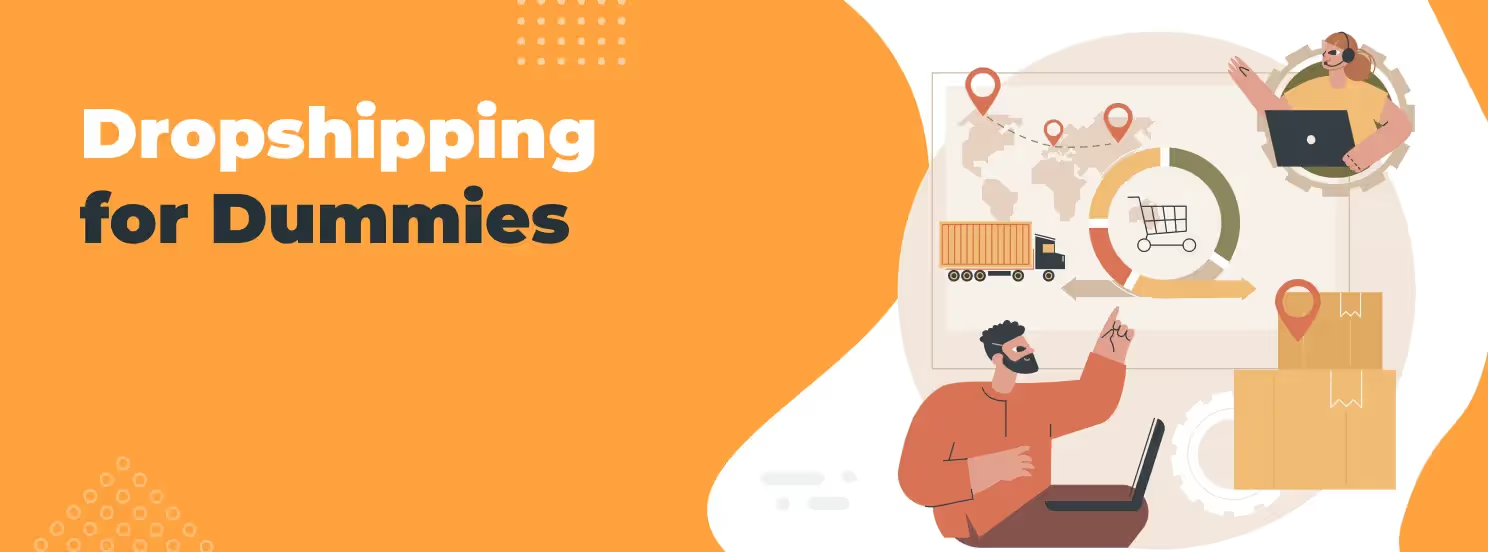
Dropshipping for dummies means understanding a simple business model where you sell products without holding inventory. You create an online store, market products, and when customers order, your supplier ships directly to them.
This guide walks you through everything you need to know to launch your first store, from choosing your niche to managing customer support. No experience required—just follow each step and you'll be running a real business within weeks.
What Is Dropshipping for Dummies?
Dropshipping for dummies is the simplest entry point into e-commerce. You don't need to buy products upfront, rent warehouse space, or hire a fulfillment team. The supplier handles all of that for you. Here's what actually happens: A customer places an order on your store, you pay the supplier their wholesale price, the supplier packages and ships the product directly to your customer, and you keep the difference as profit.
The barrier to entry is low because you're not risking thousands of dollars on inventory that might not sell. You start with just a domain name, a website, and a product list. That's it. No warehouse, no employees, no storage fees. This is why dropshipping for dummies works so well for beginners—the model removes most of the traditional business overhead that makes starting a store intimidating.
What makes dropshipping for dummies different from other e-commerce models is the speed to launch. You can have products live and ready to sell within 24 hours. No approval processes, no long supplier negotiations, no months of prep work. Just find products people want, add them to your store, and start marketing.
The A to Z of Dropshipping
Understanding dropshipping for dummies requires knowing each step from start to finish. Here's how the process works:
- A – Account Setup: Create a Shopify store or similar platform, set up your business name and domain, and choose your theme.
- B – Brand Identity: Design a logo, write your store description, and pick a color scheme that matches your target customer.
- C – Catalog Creation: Add products to your store using tools like Dropshiptool to find trending items and import them in bulk.
- D – Dropshipping Provider Selection: Choose a reliable supplier for order fulfillment, whether AliExpress, Alibaba, or a vetted platform.
- E – Email Setup: Create email automation for order confirmations, shipping updates, and abandoned cart recovery.
- F – Facebook Ads: Start running paid ads to drive traffic to your store and test which products convert.
- G – Google Analytics: Install tracking to see where traffic comes from and which products generate revenue.
- H – Hosting and Security: Use Shopify's secure hosting or similar to keep customer data safe.
- I – Inventory Management: Track stock levels with real-time syncing so you don't oversell products that are out of stock.
- J – Journeys (Customer): Map out the customer experience from landing on your store to receiving their product.
- K – Keywords: Research and use SEO keywords in product descriptions, titles, and meta tags.
- L – Logistics Partner: Connect with your supplier's shipping methods and track order fulfillment.
- M – Marketing Funnel: Build a sequence of ads, emails, and content that leads customers to purchase.
- N – Niche Selection: Choose a specific market segment instead of selling everything to everyone.
- O – Order Management: Process orders daily, update tracking information, and handle refunds when needed.
- P – Profit Calculation: Track revenue minus supplier costs minus ad spend to know your actual profit.
- Q – Quick Response: Answer customer questions within 24 hours to build trust and reduce returns.
- R – Refund Policy: Create a clear policy so customers know what happens if they're unsatisfied.
- S – Shipping Times: Set realistic delivery expectations based on your supplier's location.
- T – Testing: Run small ad campaigns to find winning products before scaling spend.
- U – Upselling: Recommend related products at checkout to increase average order value.
- V – Vendor Relationships: Build trust with suppliers through regular communication and consistent orders.
- W – Website Speed: Optimize your store so pages load in under 3 seconds—faster sites convert better.
- X – Xero or Accounting Software: Track expenses and revenue for tax purposes.
- Y – YouTube: Create product demo videos or run YouTube ads to reach new customers.
- Z – Zone In: Focus on one niche and master it before expanding to multiple product categories.
Key Pillars of Dropshipping You Should Know
Dropshipping for dummies rests on four main pillars. Master these and you'll avoid most beginner mistakes.
Pillar One: Product Selection
Your product choice determines whether you succeed or fail. Bad products kill stores no matter how good your marketing is. Use tools like Dropshiptool to analyze what's selling on successful competitor stores. Look for products with clear demand signals—high Facebook ad volume, trending on TikTok, strong Google search volume for keywords. The best products solve a real problem or fill an emotional need. Avoid saturated niches like phone cases where margins are razor-thin and competition is brutal.
Pillar Two: Supplier Reliability
Your reputation depends entirely on your supplier. If they ship slow or send low-quality products, customers blame you, not them. Before committing, order a sample product yourself. Test shipping times, packaging quality, and how the product actually performs. Don't just check one supplier—compare at least three options for each product. Dropshiptool helps you track competitor stores and see which suppliers they use, so you can learn from their choices.
Pillar Three: Marketing and Traffic
You can have the perfect product and perfect price, but if nobody sees your store, you won't sell anything. Plan to spend money on ads. Most beginners budget $5-$10 per day to start testing. Use Facebook and Instagram ads because they let you target specific demographics and interests. Track which ads generate sales and which ones burn cash without converting. Cut the losers and scale the winners.
Pillar Four: Customer Service
Dropshipping for dummies includes handling customer inquiries, returns, and complaints. Set up email automation for common questions like "Where is my order?" and "What's your return policy?" Use chatbots for 24/7 responses to basic questions. Respond personally to complaints within 24 hours. Good customer service turns one-time buyers into repeat customers and generates positive reviews that convince others to buy.
Top Trends in Dropshipping for 2026
The dropshipping landscape changes fast. Here's what winners are doing right now.
AI-Powered Product Discovery
Tools like Dropshiptool use AI to analyze millions of products and predict which ones will sell before you even run ads. Instead of guessing, you're using data. This gives you a real advantage over competitors still manually researching products.
Sustainability
Eco-friendly products, reusable items, and sustainable packaging aren't niche anymore—they're mainstream. Gen Z and millennial customers actively seek out brands with environmental values. If your store positions around sustainability, you attract loyal customers who pay premium prices.
Subscription Models
Instead of one-time purchases, offer monthly subscriptions for consumables like skincare or supplements. Subscriptions create predictable recurring revenue and increase customer lifetime value dramatically. A customer who buys once gives you $20. A customer on a $20/month subscription gives you $240+ yearly.
TikTok Commerce
Products going viral on TikTok often sell out within days. Use Dropshiptool to monitor trending products on social platforms and add them to your store while demand is hot. The timing window is narrow, but the upside is huge when you catch the wave.
Faster Shipping
Customers now expect 3-5 day delivery on domestic orders and 1-2 weeks on international. Standard AliExpress shipping (2-4 weeks) won't cut it anymore. Look for suppliers offering ePacket or DHL shipping to stay competitive.
Generic Advice You Should Avoid
Too many dropshipping guides give you vague, useless advice. Here's what actually doesn't work.
"Follow Your Passion"
Most failing dropshippers started stores selling things they love instead of things people buy. Passion doesn't pay bills. A customer in pain (needs a solution) pays bills. Pick a niche based on customer demand, not your hobbies. Use Dropshiptool to see what's actually selling right now, not what you think should sell.
"Build an Email List First"
New stores don't have traffic, so an email list of 50 people won't move the needle. Focus on driving paid traffic and converting visitors into customers first. Build email automation once you have consistent sales. Most beginners waste time on email early when they should be testing ads.
"Go With Your Gut on Pricing"
Beginners often underprice because they're afraid nobody will buy. Data beats intuition here. Look at what competitors charge for similar products. Check Dropshiptool's profit analytics to see margins on successful stores. Price based on your supplier cost plus advertising budget plus target profit. If your math doesn't work at the price point, find a different product.
"Sell Everything to Everyone"
Stores with 1,000 random products convert worse than stores with 20 carefully chosen products in one niche. Focus beats variety. Pick one specific customer problem and own it completely before expanding.
"Copy Successful Stores Exactly"
You'll see stores making six figures and think you should copy their product selection, website design, and ad copy. Copying is lazy and ineffective. Learn from them instead. Study their products, but find your own angle. Study their ads, but write your own copy. The stores that win are ones that adapt competitors' tactics to their own brand voice.
Best Tools and Apps for Newbie Dropshippers
You don't need expensive tools to start, but certain ones save hours and improve decision-making. Here are the essentials for dropshipping for dummies:
- Shopify is where you'll build your store. It's beginner-friendly, integrates with most tools, and handles payments securely. You get a free 14-day trial, then plans start at $39/month. This is non-negotiable—use Shopify for your first store.
- Alidrop or Spocket for product importing. Both sync directly with your supplier and import products with one click. Alidrop can do Alibaba, Temu, and AliExpress dropshipping, but Spocket has better supplier quality from US and EU sources. Spocket pricing starts at $39/month.
- Klaviyo for email marketing. Set up automated emails for abandoned carts, order confirmations, and win-back campaigns. Free plan available, paid plans start at $20/month.
- Facebook Ads Manager is free. This is where you'll run most of your paid traffic initially. Start with a $5/day budget and test different ad creatives and audiences.
- Google Analytics is free. Install it to track where traffic comes from and which pages convert. This data is critical for optimizing your store.
- Canva for graphics and ads. Free plan available, paid plans at $13/month. You can create Facebook ads, product images, and email graphics without hiring a designer.
How to Start Your First Store
Dropshipping for dummies starts with these concrete steps. Follow them in order.
Step One: Choose Your Niche
Pick something specific. Not "health products" but "supplements for gym beginners." Not "home decor" but "minimalist wall art." Use Dropshiptool to see what niches are trending. Check search volume on Google. Look at competitor stores using Shopify store analysis. Pick a niche where you can see at least 10-20 successful competitor stores already selling products. That's proof demand exists.
Step Two: Set Up Your Shopify Store
Go to Shopify.com, sign up, and follow their setup wizard. Choose a domain name that's short, memorable, and includes your niche keyword if possible. Pick a theme that looks professional. You don't need custom design—Shopify's free themes work fine. Install the Oberlo or Spocket app to sync products.
Step Three: Import Your First 20-30 Products
Don't import 500 products on day one. Start small. Use Dropshiptool to identify 20-30 winning products in your niche. Import them to your store. Write basic product descriptions. Upload professional product images. Set prices to cover supplier cost plus 3x markup minimum (this leaves room for ads and profit).
Step Four: Set Up Payment Processing
Enable Shopify Payments or PayPal. Both are secure and process payment automatically. No worrying about payment details—both handle everything in the background.
Step Five: Configure Shipping and Returns
Set realistic shipping times based on your supplier. If using AliExpress standard shipping, expect 14-28 days. Create a simple return policy. Most dropshippers offer 30-day returns on defective items only.
Step Six: Write Clear Product Descriptions
Don't copy descriptions from AliExpress. Write new ones focusing on benefits, not features. Instead of "Material: 100% polyester," write "Lightweight and breathable—perfect for summer workouts." Include customer pain points and how the product solves them. Add 3-5 bullet points highlighting key benefits.
Step Seven: Test Ads
Start with Facebook ads. Create 3 different ad creatives (images or short videos). Target a specific audience based on interests and demographics. Set a $5/day budget for 3-5 days per ad. Track which one generates the most sales. Scale winners, kill losers.
Step Eight: Monitor and Adjust
Check your Shopify dashboard daily. Look at which products get clicks but no sales—these need better descriptions or lower prices. Look at which products sell—consider adding similar items. Track your ad spend versus revenue. If you're spending $1 in ads to generate $3 in revenue, you're profitable. If it's $1 in ads for $1 in revenue, you're losing money.
How to Scale Up Your Store After You Start
Once you get sales, scaling means increasing revenue without proportionally increasing work. Here's the path.
Phase One: Optimize Within Your Niche (Months 1-3)
Before adding new products, perfect what you have. Test different ad angles. Refine product descriptions based on customer feedback. Lower prices on fast movers to increase velocity. Raise prices on bestsellers. Most stores double revenue in this phase just by optimizing conversion rate. Use Dropshiptool to analyze what winning competitors do with similar products.
Phase Two: Add New Products (Months 3-6)
Once you have consistent sales, add 5-10 new products monthly. These should relate to your core niche. If you sell fitness supplements, add protein shakes, workout gloves, gym bags. Use Dropshiptool to find products your current customers will want. Don't randomly add stuff.
Phase Three: Build Email Sequences (Months 3+)
Start collecting customer emails at checkout. Build automated sequences: welcome email after purchase, product review request after 1 week, related product recommendation after 2 weeks, win-back offer for customers who haven't bought in 60 days. Klaviyo handles all this automation. Email marketing generates 4x ROI on average, so this matters.
Phase Four: Expand to Multiple Ad Channels (Months 6+)
You've mastered Facebook ads. Now add TikTok ads, Pinterest ads, or YouTube ads. Each channel reaches different audiences. YouTube reaches older audiences; TikTok reaches Gen Z. Diversifying reduces dependence on any single channel and compounds growth.
Phase Five: Increase Average Order Value (Ongoing)
Add product bundles ("Buy 2, Get 10% Off"). Offer upsells at checkout ("Add this complementary item for $15"). Implement subscription options for consumables. Increase AOV by just $10 per order and watch profit skyrocket. If you sell 100 orders/month, that's extra $1,000 revenue with minimal extra work.
Roadblocks You May Run Into
Dropshipping for dummies includes dealing with real problems. Here's what typically hits new sellers.
Supplier Quality Issues
You import a product and it arrives damaged or looks nothing like pictures. Response: Test everything yourself before selling. Order samples from at least 2 different suppliers for each product. Check reviews and seller ratings. Use suppliers that Dropshiptool shows are trusted (verified track records in your database).
Slow Shipping
Customers complain orders take 6 weeks and request refunds. Response: Switch suppliers to faster shipping options. AliExpress Standard takes 2-4 weeks; ePacket takes 1-2 weeks; DHL takes 4-7 days. Faster options cost more, but worth it to keep customers happy.
Ad Costs Rising
Your Facebook ad costs climbed from $1 per click to $3, killing profitability. Response: Refresh your creative. Same ad shown repeatedly becomes invisible to audiences. Create new images, videos, or ad copy. Test new interest audiences. Season affects costs—expect higher prices around holidays. Dropshiptool shows which products have sustainable demand vs. temporary trends.
Competition Getting Fierce
New stores undercut your price, stealing your sales. Response: Differentiate on branding, not price. Add custom packaging or branded inserts. Create content showing real customers using the product. Build email list so you own customer relationships. Compete on service, not price.
Returns and Refund Requests
Customers claim products are defective or not as described, demanding refunds. Response: Set accurate expectations. Write honest product descriptions. Use real product photos. Include size guides and measurements. Some returns are natural business cost—budget 5-10% refund rate. Use Shopify's refund tools to process cleanly.
Inventory Overselling
You sell a product that the supplier runs out of stock on. Response: Enable inventory syncing in Dropshiptool or Spocket. This automatically hides products when suppliers run low. Check stock levels daily before ad spend.
Common Dropshipping Challenges and How to Address Them
Beyond roadblocks, these ongoing challenges require systems.
Customer Service Overload
When sales spike, customer emails pile up. You can't respond to 100 emails manually. Solution: Use email templates and automation. Set up Tidio or Gorgias chatbot for common questions. Create an FAQ page on your site so customers find answers before emailing. Use Klaviyo to send order updates automatically (tracking number, delivery estimate). Handle only complex issues personally. Most beginners waste 10+ hours weekly on emails that automation could handle.
Pricing Confusion
You're not sure if you're marking up enough. Is $15 profit per order good or terrible? Solution: Use Dropshiptool's profit analytics to see what margins successful stores maintain. Calculate total costs: supplier price + shipping + payment processing (2-3% of order value) + ad spend per customer + buffer for returns. Your markup should be 2-3x supplier cost minimum to cover all costs and profit.
Ad Spend Leaking
You run Facebook ads but don't know which ones work. You're guessing which ads to kill. Solution: Track UTM parameters. Create unique UTM codes for each ad so you see exactly which ad produced each sale. Use Shopify's built-in analytics to see revenue by traffic source. If an ad spends $100 but only generates $50 in sales, kill it. If it spends $100 and generates $300 in sales, scale it.
Inconsistent Income
Some weeks you get 0 orders, other weeks 50. The inconsistency makes it impossible to plan. Solution: Run consistent ad spend. If you pause ads when sales slow, sales stay slow. Maintain steady $5-10 daily ad spend even during slow periods. Seasonal products need different strategies than year-round items. Use Dropshiptool to identify seasonal trends and plan promotions around peak buying times.
Fast Shipping Times and Modes Explained
Shipping speed is now a competitive factor. Customers expect fast delivery. Here's what your options are.
Standard Shipping
14-28 days. Uses basic postal services from supplier country to US. Cheapest option but slowest. Works only for non-urgent products with patient customers. Rarely good for dropshipping for dummies starting out—customers abandon due to slow delivery.
ePacket
7-14 days. Uses tracked postal service, slightly faster than standard. Better than standard but still slow by modern expectations. Good for cost-conscious customers willing to wait.
DHL/FedEx Express
4-7 days. Tracked, reliable, insured. Costs $5-15 per shipment depending on package weight. This is the sweet spot for most dropshippers. Higher cost but fast enough that customers don't get annoyed. You can charge $5-10 for shipping and still cover costs.
Premium Express
2-3 days. Most expensive option at $15-25 per shipment. Only use for high-value items or when customers pay for rush shipping. Don't offer as default.
What’s the best strategy? Let customers choose. Offer standard shipping for $0-3, ePacket for $5-7, and DHL for $8-12. Most choose middle option. Your margin on shipping becomes extra profit.
How Much Can You Earn From Your Dropshipping Business?
A beginner running one store with consistent effort can generate $300-1,000 in the first month (after paying for ads and products). Month two usually doubles if you optimize. By month three, if you're doing everything right, you're hitting $2,000-5,000 monthly. By month six, $5,000-15,000 is realistic if you're scaling.
The best dropshippers make $10,000-50,000+ monthly from a single store. Some make more with multiple stores. The ceiling is high if you master marketing and product research.
What determines your earnings:
- Product Margins: If you mark up products 2x supplier cost, your gross margin is 50%. If ad spend is 30% of revenue and you do everything free (no tools paid), your net profit is roughly 20% of revenue. Sell $1,000 in products, keep $200 profit. Sell $10,000, keep $2,000 profit.
- Ad Spend: You need to spend money to make money. Most profitable stores spend 20-40% of revenue on ads. If you spend $1,000 on ads monthly and generate $3,000 in sales from those ads (3x ROAS), you're profitable. Most beginners see 1.5-2x ROAS initially, then improve over time.
- Work and Optimization: A passive dropshipping store doesn't exist. You need to test ads, track metrics, adjust pricing, and add new products regularly. The stores making real money spend 2-4 hours daily on the business initially. As systems improve, it drops to 1-2 hours daily.
- Seasonality: Sales spike during Black Friday, Cyber Monday, Christmas, and back-to-school. Plan for 40-50% of annual revenue coming in Q4. Use slow periods to test new products and strategies.
- Realistic timelines: 30% of people quit before making first sale. 50% make money but give up after 3-6 months because growth is slow. Only 20% stick it out and build real income. If you're in that 20%, $10,000-30,000 monthly within 6-12 months is achievable.
How to Do Better Product Research for Your Store
Product research is the skill that separates winners from losers. Here's how to do it right for dropshipping for dummies.
Step One: Find Winning Products Using Dropshiptool
Use the Product Database. Filter by category, search volume, and competitor store count. Products showing up in 50+ successful stores are proven winners—low risk. New products with only 3-5 sellers are high risk but potentially high reward. Products with zero sellers might be dead niches or untapped opportunities. Start with proven winners.
Step Two: Analyze Competitor Ads
Use Dropshiptool's Ad Spy Tool to see which ads competitors run for similar products. If a store ran the same ad for 2+ months, it's probably profitable. New ads show they're testing. Look for ad patterns—most successful ads show the product in action with real customers, not just studio shots. Most include social proof like "10,000+ sold" or customer testimonials.
Step Three: Check Profitability
Don't just see a product and add it. Calculate whether you can actually profit. Use this formula: Wholesale price + estimated shipping cost = landed cost. Landed cost × 3 = retail price. Retail price - (ad spend) - (fees) = profit. If landed cost is $5 and you can't retail it for at least $15-20, skip it. Work backward from margins, not forward from supplier price.
Step Four: Validate Customer Pain
Ask yourself: Why would someone actually buy this? What problem does it solve? If you can't articulate the customer pain in one sentence, it's not a good product. "Organize your desk" beats "wooden desk organizer." "Stop hair from tangling in brush" beats "hair brush." People buy solutions, not objects.
Step Five: Check for Competitive Saturation
Use Google Ads Keyword Planner (free) to check search volume for keywords related to your product. If 50 competitors run ads for the same keyword, you're in a crowded space. If only 5 competitors run ads, you have room. Use Dropshiptool to check competitor store counts. New niches with only 10-20 competitor stores have less ad competition than mature niches with 500+ competitors.
All About Dropshipping Analytics and E-Commerce Models
You can't optimize what you don't measure. Here's what metrics matter for dropshipping for dummies.
Traffic Metrics
- Visitors: Total people who land on your store
- Click-through rate (CTR): Percentage of visitors who click a product (should be 5-15%)
- Bounce rate: Percentage who leave without clicking anything (lower is better; target below 50%)
Conversion Metrics
- Conversion rate (CVR): Percentage of visitors who buy (2-5% is normal; 10%+ is excellent)
- Average order value (AOV): Average revenue per order (track this weekly; aim to increase it monthly)
- Customer acquisition cost (CAC): Total ad spend divided by number of new customers
Profitability Metrics
- Gross profit margin: Revenue minus cost of goods (aim for 50%+)
- Net profit margin: Revenue minus all costs including ads, fees, and tools (aim for 20%+)
- Return on ad spend (ROAS): Revenue divided by ad spend (3x ROAS means $3 revenue per $1 ad spend)
Customer Metrics
- Customer lifetime value (CLV): Total revenue from a single customer over time
- Repeat purchase rate: Percentage of customers who buy twice (higher is better; correlates to brand loyalty)
- Product return rate: Percentage of orders returned (5-10% normal; 20%+ is problem)
Track these metrics weekly in a spreadsheet. You'll spot problems (conversion rate dropped 30%) before they become catastrophes. You'll also see which products drive the best metrics, which channels perform best, and which customer segments spend most.
The E-Commerce Model for dropshipping for dummies is simple: customer order → supplier ships → customer pays → you profit. But your job is optimizing every step. Faster shipping improves repeat rates. Better product descriptions improve conversion. Targeted ads improve ROAS. Email automation improves CLV. Each improvement compounds.
Subscription Plans: Can You Offer Them?
Yes. Subscription products are increasingly popular for dropshipping. Here's how to set them up.
Subscription Products That Work
- Consumables: Supplements, skincare, vitamins (customers run out and reorder)
- Memberships: Access to exclusive groups, content, or deals
- Boxes: Curated products delivered monthly (beauty boxes, gadget boxes)
- Services: Coaching calls, training, consulting
How to Structure Subscriptions in Shopify
Enable subscription app like Bold Subscriptions or Recharge. Create a subscription product variant. Let customers choose delivery frequency (every 2 weeks, monthly, etc.). Set pricing that covers supplier cost + markup. Offer 10-15% discount vs. one-time purchase to incentivize subscriptions.
Why Subscriptions Matter
A customer buying once gives you $30 profit. A customer on a $25/month subscription gives you $300 profit annually. Subscriptions are the fastest way to scale income predictably. They also improve customer lifetime value significantly.
The catch: subscription products must be things people actually need regularly. Don't create subscriptions just because everyone talks about them. Only work for consumables or products used monthly.
Licenses and Compliance Requirements You Should Know
This is the boring stuff that protects you legally.
Business License
Register your business with your state. Operating without a business license can get expensive fines. Most states charge $50-300 and take 1-2 weeks. Required for sole proprietorships, LLCs, or corporations. Get one before taking your first sale.
Tax ID and Sales Tax
Get an EIN (Employer Identification Number) from the IRS—free and takes 10 minutes online. If you have in-state customers, you may owe sales tax. Rules vary by state. Some states require you to collect sales tax only if you have nexus (physical presence). Dropshipping changes this—most states now require you to collect sales tax even without physical presence. Use tax software like Avalara or TaxJar to handle this automatically.
Privacy Policy and Terms of Service
Write a privacy policy explaining what customer data you collect and how you use it. Write terms of service defining your refund policy, shipping times, and user responsibilities. Both are required to legally operate an online store. Use Shopify's built-in templates as starting point.
Return Policy
Clearly state what products are returnable, timeframe (30, 60 days), and condition (unopened, defective). Display on your site prominently. This reduces disputes.
Intellectual Property
Don't use trademarked product names as your store name or domain. Don't use copyrighted product images without permission. Use original product photography or royalty-free images. This keeps you out of legal trouble.
Payment Processing Compliance
PCI-DSS compliance requires secure payment processing. Shopify and PayPal handle this automatically—don't store customer credit card numbers yourself. This is non-negotiable.
How to Accept Payments From Customers
Payment processing is non-negotiable. You need to securely accept credit cards and alternative methods.
- Shopify Payments: Built into Shopify. Accepts credit cards, Apple Pay, Google Pay. Takes 2.9% + 30 cents per transaction. Money deposits to your bank account within 1-2 business days. Simple and secure.
- PayPal: Accepts credit cards, PayPal accounts, debit cards. Takes 3.49% + 30 cents per transaction. Good backup if Shopify has issues. Integrates easily with Shopify.
- Stripe: Third-party payment processor. Similar rates to Shopify Payments. Requires Shopify app integration. Useful if Shopify Payments declines you for some reason.
- Square Online or WooCommerce with Square: If not using Shopify, Square offers payment processing. Useful for businesses preferring open-source platforms.
For most beginners, Shopify Payments is the only option needed. It's secure, built-in, and requires zero setup. Accept credit cards and move on.
Abandoned Carts: How to Recover Lost Sales
Abandoned carts are revenue left on the table. On average, 70% of visitors abandon carts without buying. But 15-30% can be recovered with the right follow-up.
Automated Abandoned Cart Sequence
- 1-hour after abandonment: Send email reminding them what's in the cart. Include product image and price. No pressure. Just "Hey, you left something behind."
- 24 hours after abandonment: Send second email with 10% discount code. Create urgency: "Only for the next 48 hours." Include customer testimonials or reviews to build confidence.
- 72 hours after abandonment: Final email with higher discount (15%) and urgency message: "Only 24 hours left at this price." If they still don't buy, let them go. Contacting again will just annoy them.
You can set this up in Klaviyo or use Shopify's built-in Abandoned Cart Recovery app. Most recover 5-15% of abandoned carts, which is direct profit. If you average $5,000 monthly revenue, 70% abandoned is $3,500 lost. Recovering 15% of that is $525 extra monthly with zero extra work.
Email Marketing and Copywriting Basics for Dropshippers
Email is your owned channel. Social media owns your audience; email belongs to you.
Email Marketing Fundamentals
Build a list by offering incentive at checkout (10% off first order). Send welcome email within 1 hour of signup. Send product recommendation email 3 days later. Send abandoned cart sequences. Send post-purchase sequences. Send re-engagement campaign for inactive subscribers (60+ days no open or click).
Copywriting Basics
Write subject lines that create curiosity, not fake urgency. "3 ways to [solve your problem]" outperforms "URGENT: Only 24 hours!" Studies show curiosity beats artificial scarcity for email opens.
- Personalization works: "Sarah, your order ships today" outperforms "Your order ships today"
- Benefits beat features: "Sleep better" beats "Cooling gel pillow"
- Social proof converts: Include customer reviews, testimonial quotes, user counts
Email Types That Sell
- Welcome series: Introduce brand and values
- Product recommendation: Suggest items based on purchase history
- Abandoned cart: Remind + offer discount
- Post-purchase: Ask for review, recommend related items
- Re-engagement: Win back inactive customers with offer
- Win-back: Last-chance offer before removal from list
For most dropshipping for dummies stores, 5-7 automated sequences running in Klaviyo generate 30-40% of monthly revenue. That's passive income after initial setup.
Automating Your Dropshipping Business
As your store grows, automation saves sanity and money.
Order Fulfillment Automation
Use Dropshiptool or similar to automatically send orders to supplier. When customer purchases, the order syncs to your supplier account. Supplier ships directly to customer. You don't manually process anything. Money saves time and errors.
Inventory Synchronization
Enable real-time inventory syncing. When a supplier runs low on stock, your store automatically hides that product. Prevents overselling. Prevents customer disappointment.
Email Automation
Set up sequences in Klaviyo to run 24/7 without your intervention. Abandoned carts, welcome series, post-purchase follow-ups all run automatically. Result: steady revenue from automation alone.
Ad Automation
Use Facebook's Advantage+ Shopping Campaigns (Facebook's AI automatically optimizes your ads). Instead of managing individual ads, feed good products into the system and let Facebook's algorithm run them. Less hands-on but good starting point.
Customer Service Automation
Chatbots answer common questions 24/7. "Where's my order?" gets an instant response with tracking. "What's your return policy?" gets policy. "Do you ship internationally?" gets your shipping info. Only complex issues need human response.
Product Feed Automation
Use Dropshiptool to automatically import new trending products weekly. Or use Oberlo/Spocket to bulk import curated products. No manual listing one by one.
The automation goal: spend 1 hour daily doing high-impact work (testing ads, customer calls for feedback, strategy) and let systems handle the rest.
Human Feedback in Your Automation
Automation handles repetitive tasks, but human judgment makes the final decisions.
What Stays Manual
- Choosing product niches (AI can't predict your market)
- Setting ad budgets and bid amounts (requires judgment on profit targets)
- Reading customer complaints (AI misses nuance; emotional issues need personal response)
- Strategic pivots (scale winners, kill losers—requires human analysis)
Feedback Loop
Check metrics daily. Are customers happy? Is conversion rate staying steady or dropping? Are returns increasing? Use Dropshiptool's analytics to spot patterns. AI might flag that conversion rate dropped 20%, but you decide if it's a seasonal trend, product issue, or marketing problem.
Respond to 5-10 customer emails personally weekly. This teaches you what's actually happening with your business. Automation handles volume, but humans catch problems before they become catastrophes.
Streamline Order Management and Fulfillment
Order management is simple if you have the right systems.
Daily Process
- Morning: Check Shopify dashboard for new orders
- Fulfill orders using Dropshiptool with one click (auto-sends to supplier)
- Send tracking update to customers immediately
- Answer customer service emails
- Check ad performance and adjust spend if needed
Weekly Process
- Analyze top performing products
- Analyze best converting ads
- Adjust pricing on slow movers
- Consider which new products to add
- Check inventory levels
Monthly Process
- Calculate profit margin
- Analyze customer acquisition cost
- Plan ad budget for next month
- Review email metrics
- Decide on scaling strategy (add products, add ads, add channels)
This routine takes 1-2 hours daily if you have automation in place. Without automation, it takes 4-6 hours. Use Dropshiptool to save the most time on product tracking and competitor analysis.
Where Dropshiptool.io Fits in Your Business
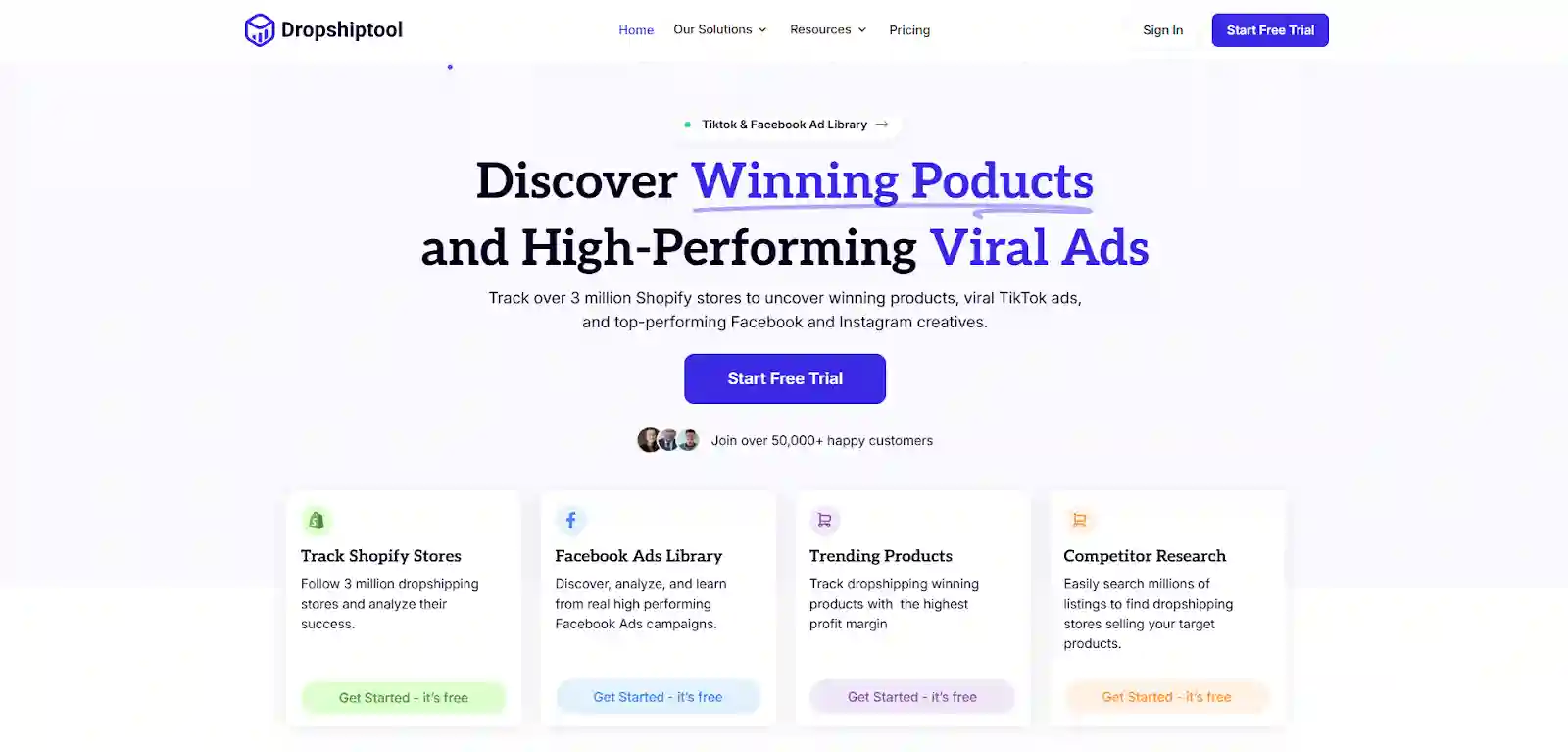
Dropshiptool solves the biggest pain point for new dropshippers: finding winning products. Here's how to use it.
Finding Your First Products
Use Dropshiptool's Product Database to search your niche. Filter by competitor count, search volume, and product category. Look at products showing strong sales in 20+ competitor stores—these are proven winners. Import these to your store to start with safety.
Understanding Competitor Strategy
Use Sales Tracker to see what competitors are actually selling. Check their top 10 products, pricing, and estimated monthly revenue. This shows you exactly what's working in your niche without guessing. Dropshiptool shows you data from over 3 million Shopify stores.
Validating Ad Spend
Use Ad Spy Tool to see which ads competitors run for your products. How long are they running? How many engagement signals do they get? If a competitor ran the same ad for 6 months, it's probably profitable. If they switch ads every 2 weeks, their ads might be losing effectiveness.
Pricing Strategy
Use Dropshiptool's competitor research to see markup percentages on winning stores. If competitors markup 2.5x supplier cost on average, match that. If they mark up 4x on premium products, try it. You see what actually works in your market instead of guessing.
Staying Ahead of Trends
Check Dropshiptool's trending products section weekly. See what's gaining traction before saturation. First-mover advantage is huge. If you find a product going viral when only 5 competitors have it, add it now. In 3 months, 100 competitors will have it and your advantage is gone.
Dropshiptool's Pricing
The free plan includes basic searches. Starter at $39/month covers most beginner needs. Professional at $59/month adds more searches. Empire at $99/month includes higher limits. Unicorn at $299/month is for power users. Most beginners never need more than Professional.
Conclusion
Dropshipping for dummies works because it removes startup barriers. No inventory, no warehouse, no employees—just a store and marketing. Your first 30 days should be setting up your store and launching your first ads. Your first 90 days should be hitting consistent sales and optimizing conversion.
Your first year should be scaling to $5,000-15,000+ monthly if you execute properly. The model is proven. The tools exist. Success depends on you actually doing the work, not waiting for a perfect plan. Start this week with your niche research, not next month with your perfect strategy. Dropshipping for dummies is simple to understand but requires consistent action to succeed. So try Dropshiptool today!